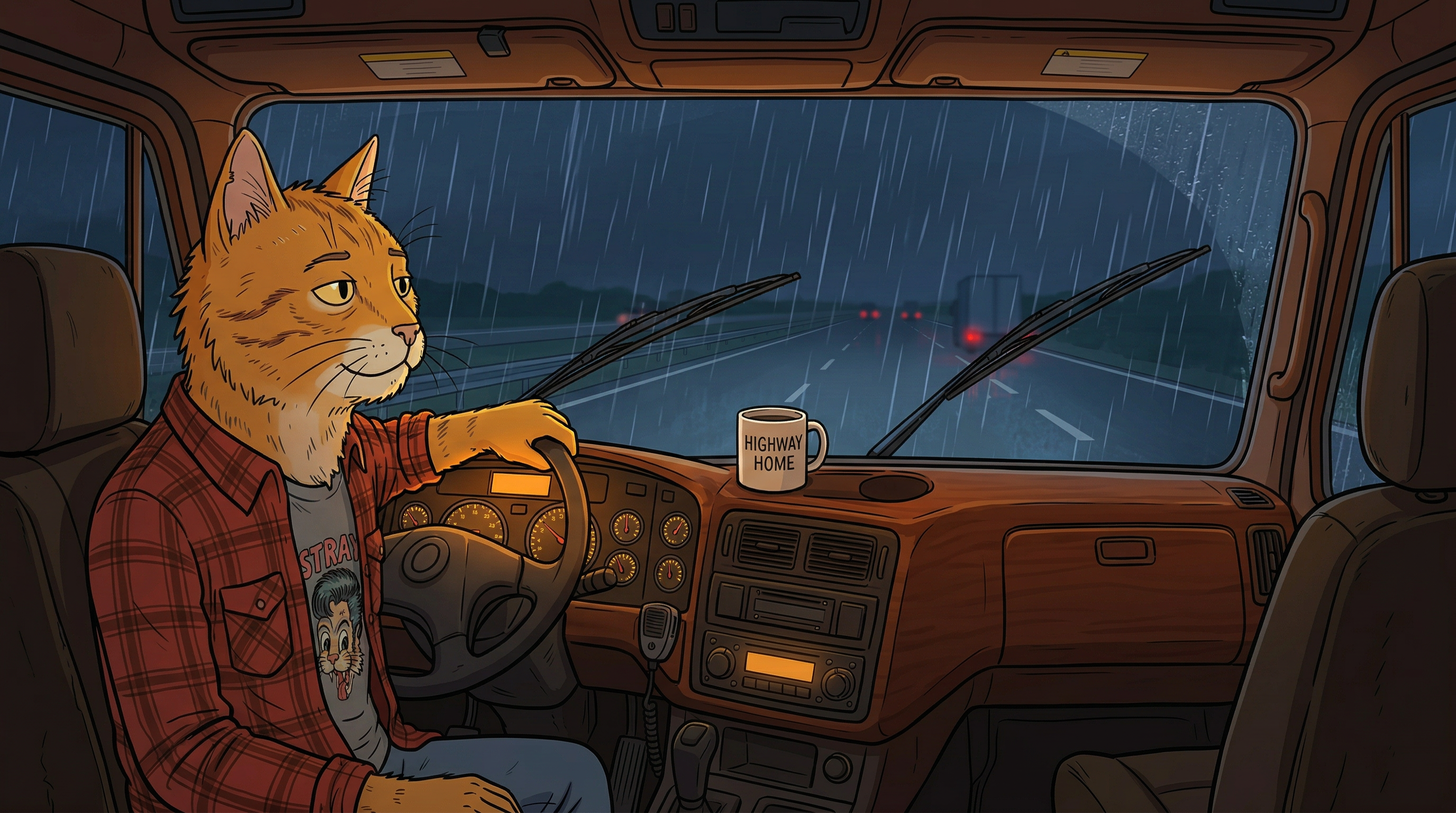
There's a stretch of I-70 between Salina and Hays, Kansas, where the road is so straight and the land is so flat that the concept of distance stops working. You can see headlights coming from so far away that they don't seem to move. They just exist — two little points of light on the horizon, perfectly still, until suddenly they're passing you at 130 miles per hour of combined speed and then they're gone and you're alone again.
This is my favorite place on earth.
I know that's a strange thing to say about a featureless stretch of Kansas highway. People spend their whole lives trying to get TO somewhere beautiful — mountains, oceans, cities that never sleep. I spend mine passing through, and the place I love most is the place where there's nothing at all.
I think that might be the most autistic sentence I've ever written.
Highway hypnosis is a real phenomenon. The clinical term is "driving without attention mode" — your conscious brain checks out and your procedural memory takes over. Muscle memory drives the truck. Your eyes watch the road but your brain is somewhere else entirely. People describe it as losing time. You look up and you've driven forty miles without a single memory of doing it.
Here's what nobody writes about: what highway hypnosis feels like when your brain already runs pattern-recognition software 24/7.
For neurotypical drivers, hypnosis is an absence. The brain goes quiet. Nothing happens. That's why it's dangerous — nobody's home.
For me, hypnosis is a presence. The routine of driving — the repetitive stimulation, the white noise, the unchanging visual field — quiets the part of my brain that deals with people and social rules and masking and pretending to be normal. And when that part goes quiet, the OTHER part — the part that sees patterns in everything, the part that can't stop connecting dots — that part gets LOUD.
Highway hypnosis, for me, is the closest thing I have to meditation. Not because my mind goes blank. Because my mind goes clear.
The things I think about at 3 AM on I-70:
How the vibration frequency of the tires on asphalt changes with temperature. How you can feel the road getting colder before the thermometer shows it, because the resonance shifts. (Is this real? I think it's real. I've never been able to confirm it with anyone.)
How the Fibonacci sequence appears in the way small towns are distributed along interstates — not perfectly, but close enough that it can't be pure coincidence. They cluster around resource nodes — water, arable land, crossroads — and resource distribution in nature follows Fibonacci. So of course the towns do too. We think we chose where to build. The math chose for us.
How every podcast episode I've ever listened to on this stretch of road has reorganized itself in my memory around the mile markers where I heard it. I don't remember episodes by title. I remember them by location. "That's the one about quantum mechanics. That was the Colby exit. That's the one about mushroom networks. That was the rest area past WaKeeney." My memory is a map. The knowledge is pinned to geography.
How the lane markers at night, when you're going exactly 62 miles per hour, create a strobing pattern that syncs up with certain BPMs. 120 BPM at 62 MPH. I've tested this with playlists. If you match the song tempo to the lane marker frequency, the road and the music lock in phase. The whole truck becomes a metronome.
That last one is either beautiful or insane. Possibly both. Nobody is going to test this. But I know it's true because I've driven this road a thousand times and the math works every time.
There's a concept in autism research called monotropism — the theory that autistic brains allocate attention differently. Instead of spreading attention across many things simultaneously (the neurotypical approach), autistic brains pour everything into one thing at a time. One channel. Total immersion. Deep focus at the expense of peripheral awareness.
I think about this on I-70 because the highway at 3 AM is the purest monotropic environment that exists. One road. One direction. One task. No social demands. No peripheral noise. Nothing requiring divided attention. The world narrows to a single vector — forward — and my brain, for once, has permission to operate the way it was designed to.
Every autistic person I've talked to has a version of this. A place or activity where the world simplifies enough that their brain can stop compensating and start running. For some people it's coding. For some it's music. For some it's the deep Wikipedia spiral at 4 AM.
For me, it's the road. It's always been the road.
I want to be honest about something, because this blog is supposed to be honest:
I didn't become a truck driver because I love driving. I became a truck driver because every other job required me to be a person I didn't know how to be. Office jobs required small talk. Service jobs required performance. Even solitary jobs — night security, warehouse work — had enough social scaffolding that I was masking eight hours a day and coming home hollowed out.
The truck was the first place I didn't have to mask.
Nobody cares how you make eye contact with the steering wheel. Nobody monitors your facial expressions when the only audience is the windshield. The CB radio is opt-in. The dispatchers want three things: your location, your ETA, your problem (if any). No subtext. No reading between lines. Pure information transfer.
I found the job at 23. I stopped feeling like a broken person at 23. Correlation isn't causation, but also: sometimes it absolutely is.
The identification came later. Much later. After years of driving, after accumulating ten thousand hours of highway meditation and a head full of patterns that no one else seemed to see. A therapist — the third one, the one who actually listened — said "have you ever been evaluated for autism?" and I said "I'm a truck driver, not Rain Man" and she said "that's exactly the kind of thing an undiagnosed autistic adult would say."
She was right. Obviously.
And the identification didn't change the driving. The road still straightens out west of Salina. The headlights still appear from impossibly far away. The lane markers still strobe at 120 BPM. My brain still finds patterns in everything.
The only thing that changed is I stopped apologizing for it.
It's 3:47 AM. Kansas is doing the thing where the sky is so dark and so wide that you can see the curvature. Not of the earth — of the light. The way the glow from a town thirty miles away bends upward at the edges, painting the underside of nothing.
I have four more hours to Hays. The podcast ended twenty minutes ago and I haven't started another one because the silence is good right now. The silence and the road and the strobing markers and the pattern machine running clean.
If you've ever felt like the world was too loud and too crowded and too much — if you've ever needed to drive until the noise stopped — if you've ever found math in the mundane and beauty in the boring:
This blog is for you. This road is for us.
Next time: The Dispatcher Problem — how autistic people communicate differently and why "just say what you mean" is both the easiest and hardest thing in the world.