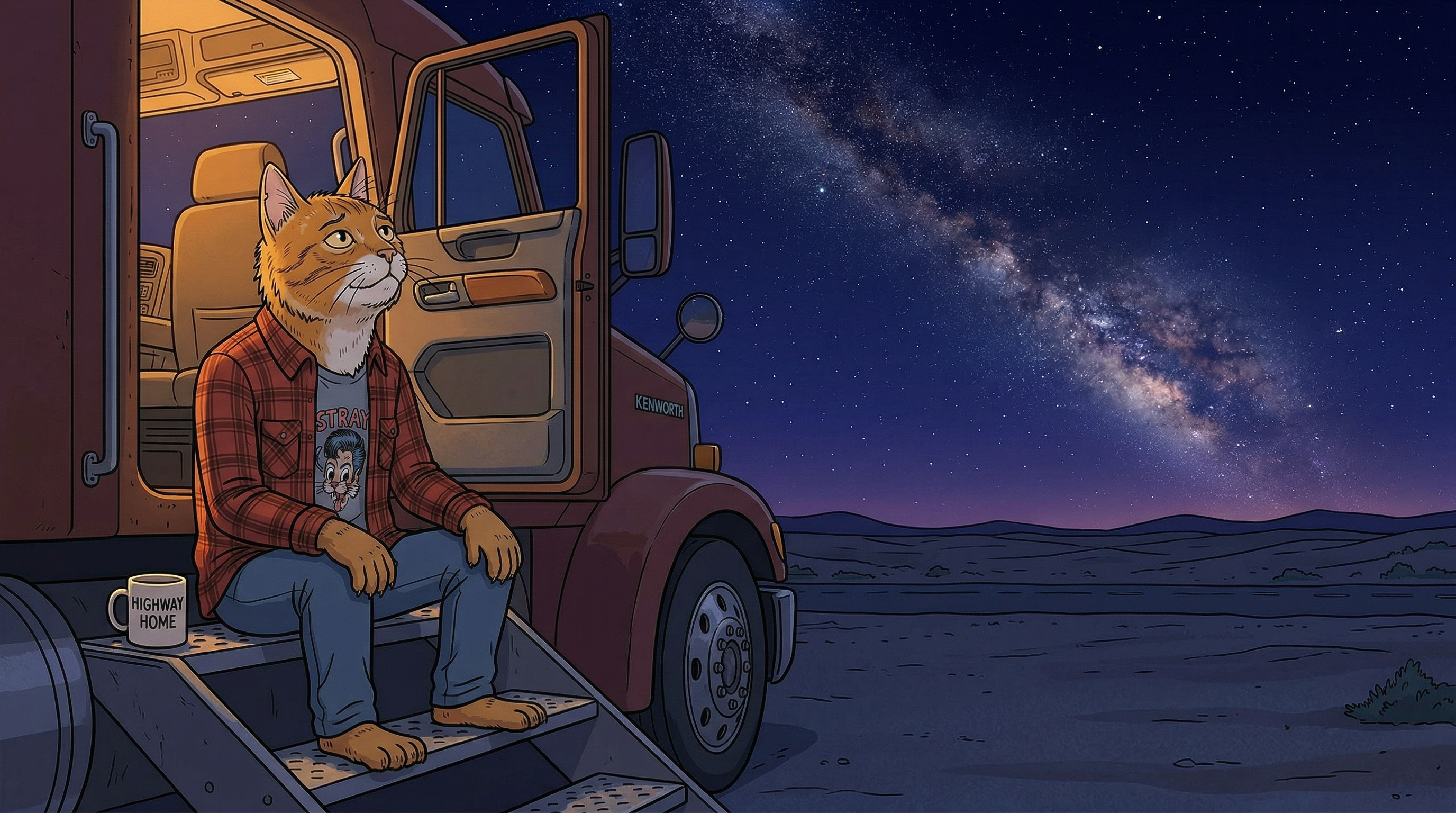
There's a stretch of US-50 in Nevada that the state tourism board literally calls "The Loneliest Road in America." They put it on signs. They sell survival kits to people planning to drive it. When Life magazine ran the original article in 1986, they warned readers there was "no place to stop and virtually nothing to see." The state responded by leaning into it — printing bumper stickers, creating a "Highway 50 Survival Guide," turning the emptiness into a brand.
I love this. I love it the way I love everything that takes the thing people say is wrong with it and makes it the point.
I went to a family thing last week. An aunt's birthday. Catered. Thirty people in a house designed for twelve.
I lasted ninety minutes.
Here's what ninety minutes cost me, itemized the way I itemize everything because that's how my brain works and I've stopped apologizing for it:
Minutes 0-15: Arrival. Masking initialization. Smile. Eye contact (calibrated: long enough to seem engaged, short enough to not seem intense). Hug protocol (one-armed, brief, matching pressure to the other person's lead). Small talk subroutine loaded. "How's work?" "Good, busy." "You?" "Same." This is not conversation. This is handshake protocol. Both parties know it. Nobody admits it. Minutes 15-40: The social middle. Cross-room navigation. Identify the person I actually want to talk to (cousin, the one who reads). Get intercepted by three people I don't want to talk to. Each interception costs energy. Not because they're bad people — because each one requires loading a different masking profile. The uncle who needs you to laugh at his jokes. The aunt who needs you to ask about her hip. The cousin's new boyfriend who needs you to seem interested in his truck (I am genuinely interested in his truck but this is not the right amount of interest to display — recalibrate). Minutes 40-70: I find the cousin. We talk about a book. For eight minutes, I am not masking. My shoulders drop. My voice changes — gets flatter, more real, less performed. She doesn't notice the shift because she's one of the few people I don't have to perform for. These eight minutes are the only real minutes in the whole event. Minutes 70-85: The tank is approaching empty. The noise is no longer background — it's become the primary signal. Every conversation happening simultaneously registers individually. I can hear the uncle's joke from across the room AND the aunt's complaint about her hip AND the boyfriend's truck story AND a child somewhere doing whatever children do. My brain refuses to filter any of it. Everything is foreground. Minutes 85-90: Exit protocol. "I gotta head out, early morning." Hug protocol (reversed). Smile (degraded — the mask is slipping). Walk to the truck. Close the door. Silence. Minutes 90-???: Sit in the truck in the driveway for twenty minutes with the engine off, unable to move, because the social firmware is still running and it takes time to uninstall.There's a movie — animated, about a fox — where the main character has a job and a wife and a kid and a house and does all the things you're supposed to do. And then one night he looks at a wild wolf on a hill and something in him recognizes it and he raises a fist and the wolf raises a fist back and they stand there, two wild things, one pretending to be tame and one that never had to pretend.
I think about that scene a lot.
The thing about masking — the thing that's hard to explain to people who don't do it — is that it's not lying. Not exactly. It's more like... translation. You take what's happening inside (the real response, the actual feeling, the natural behavior) and you translate it into something the social environment can receive without breaking.
The real response to "how's work?" is a twelve-minute technical monologue about a routing pattern I noticed in the dispatch system.
The translated response is: "Good, busy."
The real response to a hug from someone I'm not close to is full-body rigidity and a desire to leave.
The translated response is: a one-armed squeeze and a smile.
The real response to being in a room with thirty people and sixty simultaneous conversations is to sit in a corner and either catalogue every sound source or leave immediately.
The translated response is: mingle. Laugh. Eat a thing from the tray. Ask about the hip.
Every single social interaction I've ever had involves this translation layer. Every one. Even the good ones. Even with people I love. The mask isn't a choice — it's a reflex, installed so early and so completely that for thirty-some years I didn't know I was wearing one. I just thought social interaction was supposed to be that exhausting for everyone.
The identification changed the mask. It didn't remove it — you can't remove something that's been load-bearing for three decades without the whole structure coming down. But it changed my relationship to it.
Before identification: I mask because that's how socializing works. Everyone finds this draining. I'm just bad at it.
After identification: I mask because my natural social firmware is incompatible with the standard protocol. The exhaustion isn't failure. It's the cost of running a translation layer on every single interaction, forever.
That shift — from "I'm bad at this" to "I'm doing something extra that most people don't have to do" — is enormous. It doesn't reduce the exhaustion. But it removes the shame.
The fox isn't broken for being a fox. He's just living in a world that requires him to pretend he's a dog.
Here's the part that's harder to talk about:
Sometimes I don't want to take the mask off.
I know the neurodiversity community has strong feelings about this. Masking is harmful, masking is self-erasure, masking is internalized ableism. And — yes. All of that can be true. But also:
The mask is mine. I built it. Over decades, in the dark, without instructions. It's custom work. It's GOOD work. It gets me through family events and dispatch calls and the occasional human interaction at a truck stop where the waitress asks how my day was and I say "good" instead of "I've been thinking about Fibonacci sequences in highway infrastructure for the last three hundred miles."
The mask is a tool. Like the truck. Like the headphones. Like the route I take through a parking lot that minimizes the number of people I have to walk past.
The goal isn't to destroy the mask. The goal is to know you're wearing one. To choose when to put it on and when to take it off. To understand the cost and decide when the cost is worth paying.
At the family thing? The cost was worth it. For those eight minutes with my cousin. For the fact that my aunt knows I showed up for her birthday. For the small, real human connections that exist underneath all the protocol.
In the truck at 3 AM? No mask needed. The cab is the place where I don't translate. The road doesn't require a social protocol. The patterns don't need to be hidden. I am exactly what I am out here, and what I am is a man with a brain that won't stop finding order in everything, driving through the dark, listening to music, and writing about it for an audience that may or may not exist.
US-50. The Loneliest Road in America. They put it on the signs like it's a warning.
It's not a warning. It's a promise.
There is nothing out here but the road and the sky and the patterns and the music and the silence that isn't silent because my brain doesn't do silent, but is at least MINE, uncommented upon, untranslated, unmasked.
I am a wild animal. This is my hill.
And if another wild animal reads this from their own version of the hill — their own cab, their own 3 AM, their own loneliest road — and raises a fist:
I see you. I raise one back.
Next time: The Dispatcher Problem — why "just say what you mean" is the most neurotypical advice ever given, and what happens when you actually try it.