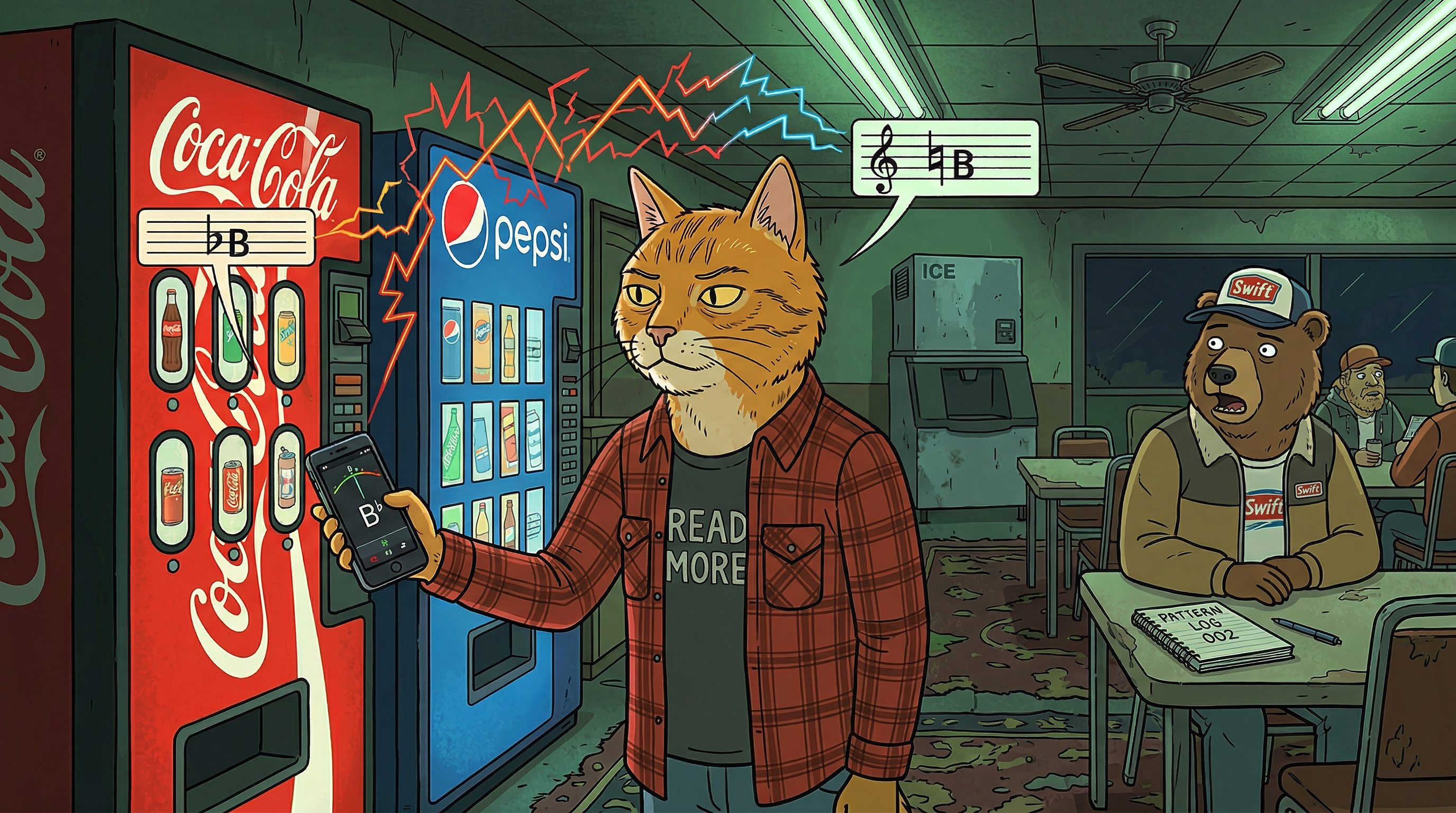
Vending machines hum at specific pitches, and the pitch correlates with the brand.
BACKGROUND:
I notice sounds that other people don't notice. This is not a superpower. It's a tax. Every environment has a sound floor — the aggregate of every mechanical, electrical, and atmospheric source producing audio in that space. Most people's brains filter this into "background noise" and discard it. My brain catalogs it. Alphabetically, by frequency, cross-referenced with location.
Truck stop lounges are rich acoustic environments. You have: the ice machine (rhythmic compressor cycle, ~90 seconds on, ~120 seconds off), the fluorescent lights (60 Hz buzz, always, everywhere, the most reliable sound in America), the coffee maker (heating element whine, variable by age of unit), the door chime (electronic, usually C5 or D5), and the vending machines.
The vending machines are the loudest quiet thing in the room.
METHOD:
Over approximately fourteen months of truck stop visits, I used a guitar tuner app on my phone to measure the dominant hum frequency of vending machines. Sample size: 73 machines across 29 states. I recorded the brand, the location, and the pitch.
I am aware of how this sounds.
DATA (summarized):| Brand | Dominant Pitch | Note (nearest) | Sample Size | Confidence | |---|---|---|---|---| | Coca-Cola (standard cooler) | 233-237 Hz | B♭3 | 22 machines | High | | Pepsi (standard cooler) | 245-250 Hz | B3 | 18 machines | High | | Dr Pepper (standalone) | 228-234 Hz | A♯3/B♭3 | 8 machines | Medium | | Snack machines (generic) | 118-122 Hz | B♭2 | 14 machines | High | | Red Bull cooler (small) | 340-355 Hz | F4 | 6 machines | Low | | Monster Energy (full-size) | 230-240 Hz | B♭3 | 5 machines | Low |
OBSERVATION WITHIN OBSERVATION:
Coca-Cola machines and generic snack machines hum at the same note — B♭ — separated by one octave. The snack machine is B♭2 (low), the Coca-Cola cooler is B♭3 (one octave up). They harmonize. If you stand between them, which I have, many times, at many truck stops, the two B-flats produce a consonant interval that is actually kind of beautiful in a way that no one has ever appreciated because no one stands between vending machines listening for harmonic intervals at 2 AM except me.
Pepsi machines are a half-step sharp. B3. This creates a semitone dissonance with the Coca-Cola machine when both are present. Stand between a Coke machine and a Pepsi machine and you hear a minor second interval — the most dissonant interval in Western music. The Cola Wars are being fought in frequencies and neither side knows it.
HYPOTHESIS:
The pitch is determined by the compressor motor. Compressor motors in commercial refrigeration units run on 60 Hz AC power (in the US) and the mechanical resonance of the unit — the motor mount, the cabinet material, the internal volume of the cooling chamber — determines which harmonic of the base frequency becomes dominant.
Coca-Cola uses specific refrigeration units from specific manufacturers (True, Frigoglass, Imbera). These units share mechanical properties that produce resonance at or near 233 Hz, which is B♭3. It's not intentional. It's a manufacturing fingerprint. Every Coca-Cola machine on the continent is singing the same note because they're all built the same way.
Pepsi uses different manufacturers. Different resonance. Different note.
The vending machine doesn't know what key it's in. But it's always in the same key.COUNTERARGUMENT:
My sample size is 73 machines. There are approximately 7 million vending machines in the United States. I have sampled 0.001% of them. The pitch variations within each brand (233-237 Hz for Coke, 245-250 Hz for Pepsi) suggest that individual unit age, temperature, ambient conditions, and mechanical wear all affect the exact frequency. I might be hearing a tendency and calling it a law.
COUNTERARGUMENT TO THE COUNTERARGUMENT:Manufacturing standardization means that compressor units of the same model will produce similar resonance regardless of where they're deployed. The variation I'm measuring (±4 Hz for Coke, ±5 Hz for Pepsi) is within the range you'd expect from temperature and age variables. The central tendency holds. The note is real.
PRACTICAL APPLICATION:
None. This has no practical application. I can't use this information for anything. It doesn't make me a better driver, a better person, or a more effective member of society.
But I know it. I can't un-know it. And now every truck stop lounge is a concert hall performing a piece that nobody wrote, nobody conducts, and nobody hears.
Except me. Apparently.
STATUS: Partially confirmed. Need more samples in the Pacific Northwest (different power grid characteristics may affect base frequency) and the Southeast (higher ambient temperatures may shift resonance). Also need to test whether altitude affects pitch — the Love's in Flagstaff (7,000 feet) seemed sharper than the Love's in El Centro (below sea level) but n=1 is not data. PERSONAL NOTE:
I showed this data to another driver at the fuel island last week. He looked at me for approximately 4.5 seconds without blinking, which per my eye contact model is 1.5 seconds past the comfortable threshold for a stranger interaction, and said, "Man, you need a hobby."
I have a hobby. This is the hobby.
Next time: Cab Note #003 — on the specific loneliness of being the smartest person in a room who can't prove it and doesn't want to.