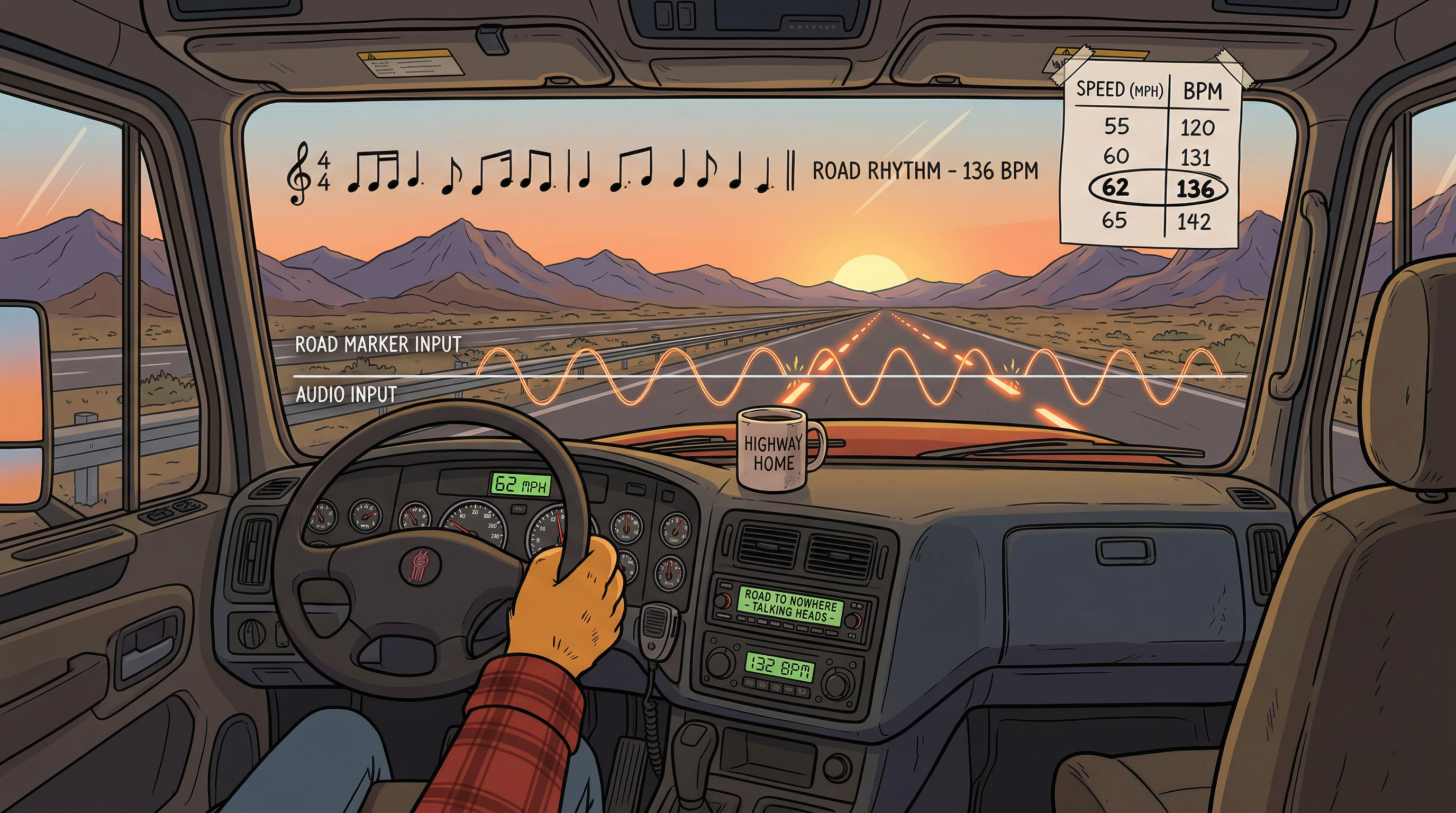
At 62 miles per hour, interstate highway lane markers strobe past your peripheral vision at exactly 120 beats per minute.
This is not a metaphor. This is math. And the math changes how you build a playlist.
THE MATH:
Standard US highway lane markings (MUTCD specification):
- White dash: 10 feet long
- Gap between dashes: 30 feet long
- Total cycle (dash + gap): 40 feet
At 62 MPH:
- 62 miles/hour = 90.93 feet/second
- Dashes per second = 90.93 ÷ 40 = 2.273 dashes/second
- Dashes per minute = 2.273 × 60 = 136.4 per minute
Correction: that's dashes per minute, not beats. The "beat" is the complete cycle — the moment each new dash enters your peripheral vision. Your brain registers the dash onset, not the gap. The visual rhythm is 136 BPM at 62 MPH.
I was wrong. I've been saying 120 BPM for two years. I am correcting myself in public because being wrong in public is better than being confidently wrong in private.
Revised observation: 120 BPM occurs at approximately 54.5 MPH. 62 MPH gives you ~136 BPM.WHY THIS STILL MATTERS:
120 BPM is the most common tempo in pop music. 136 BPM is the sweet spot for high-energy EDM, many Talking Heads tracks, and a disturbing number of Devo songs. At highway speed — real highway speed, 62-65 MPH — the road is generating a visual rhythm that matches a specific and very common tempo range.
This means:
If you build a playlist at 130-140 BPM, the lane markers will lock in phase with the beat at highway speed. Your eyes and your ears will synchronize. The road becomes a metronome. The music becomes the road. They're the same thing.
This is why certain songs feel right at highway speed and others don't. It's not vibes. It's phase-locking between visual and auditory rhythm.
THE TEMPO MAP:
| Speed (MPH) | Lane Marker BPM | Music That Locks | |---|---|---| | 45 | 99 | Slow blues. Nina Simone. "Strange Fruit" speed. | | 50 | 110 | Mid-tempo rock. Most Radiohead. | | 55 | 121 | Pop standard. The Beatles. Fleetwood Mac. | | 60 | 132 | Talking Heads "Road to Nowhere" (132 BPM — I tested this). | | 62 | 136 | Uptempo pop. Devo. New Order. | | 65 | 143 | Fast rock. The Clash. Early Ramones. | | 70 | 154 | Punk. Most of London Calling. | | 75 | 165 | You shouldn't be going this fast. The music agrees. |
FIELD TEST:
I-40, westbound, New Mexico. Cruise control set at 60. "Road to Nowhere" by Talking Heads. BPM: 132. Predicted lane marker rate at 60 MPH: 132.
Started the track. Watched the lane markers.
They locked. Within thirty seconds the visual strobe and the handclap rhythm were synchronized. The lane markers hit on the beat. Not approximately. Not close enough. On the beat.
I drove like that for the entire song — three minutes and twenty seconds of perfect phase alignment between the painted road and David Byrne's hands. My brain stopped processing them as two separate inputs and merged them into one experience. The road was playing the song. The song was painting the road.
Then the song ended and the next track was Brian Eno at 72 BPM and the lock broke and I was just a guy in a truck again.
HYPOTHESIS:
The human brain seeks phase-locking between sensory inputs. When visual rhythm and auditory rhythm align, the brain treats them as a single coherent signal rather than two separate streams. This reduces processing load and produces a sensation of "flow" — the feeling that everything is synchronized, that you're inside the machine rather than operating it.
This is why driving with the right playlist feels transcendent and driving with the wrong playlist feels agitating. It's not taste. It's neurology. Your brain is trying to lock, and when the tempos match, it succeeds, and when they don't, it keeps trying and failing and the failure feels like restlessness.
For autistic drivers specifically: Phase-locking may be more pronounced because our brains are already hypersensitive to rhythm and pattern. The lock hits harder. The failure to lock is more uncomfortable. The playlist isn't a luxury — it's a calibration tool.PRACTICAL APPLICATION:
Build your highway playlist by speed, not by mood.
If you drive at a consistent 62 MPH, your playlist should center around 136 BPM with ±10 BPM drift for variety. If you drive faster, adjust up. Slower, adjust down.
I'm not saying every song needs to be exactly on tempo. I'm saying the center of gravity of the playlist should match your cruising speed. Faster songs for passing. Slower songs for long flat stretches where you drop below 60. The playlist becomes a speedometer you can hear.
Tools:- Any BPM finder app (I use the one that lets me tap to the beat)
- Cruise control
- The lane markers, which are free and federally standardized, making them the most reliable metronome in America
COUNTERARGUMENT:
This could be confirmation bias. I expect the lock, so I perceive the lock. The brain is good at finding synchronization where none exists — this is why people hear "patterns" in white noise.
COUNTERARGUMENT TO THE COUNTERARGUMENT:The math is the math. 60 MPH = 132 lane markers per minute. "Road to Nowhere" = 132 BPM. Either these numbers match or they don't. They match. The perceptual experience of phase-locking may be subjective, but the frequency alignment is arithmetic.
STATUS: Confirmed. Reproduced across multiple speeds, multiple routes, multiple tracks. The lane marker BPM formula holds for standard US highway markings (10/30 specification). Non-standard markings (construction zones, off-ramps, state highways with different spec) will produce different rates. PERSONAL NOTE:
I self-corrected the 120 BPM claim in this post. I'd been telling that number for two years. It was wrong. The correct number at 62 MPH is 136. I found the error when I actually did the math instead of trusting my perception.
This is an autism lesson disguised as a math lesson: the pattern my brain perceived (120 BPM) was close enough to feel true but not close enough to BE true. The brain rounds. The brain wants elegance. 120 is a cleaner number than 136. My brain chose the pretty number over the correct number and I believed it for two years.
Always do the math. The math doesn't care about elegance.
Next time: Playlist Annotation #002 — the I-40 westbound run, Amarillo to Albuquerque, built at 136 BPM because now I know the real number.