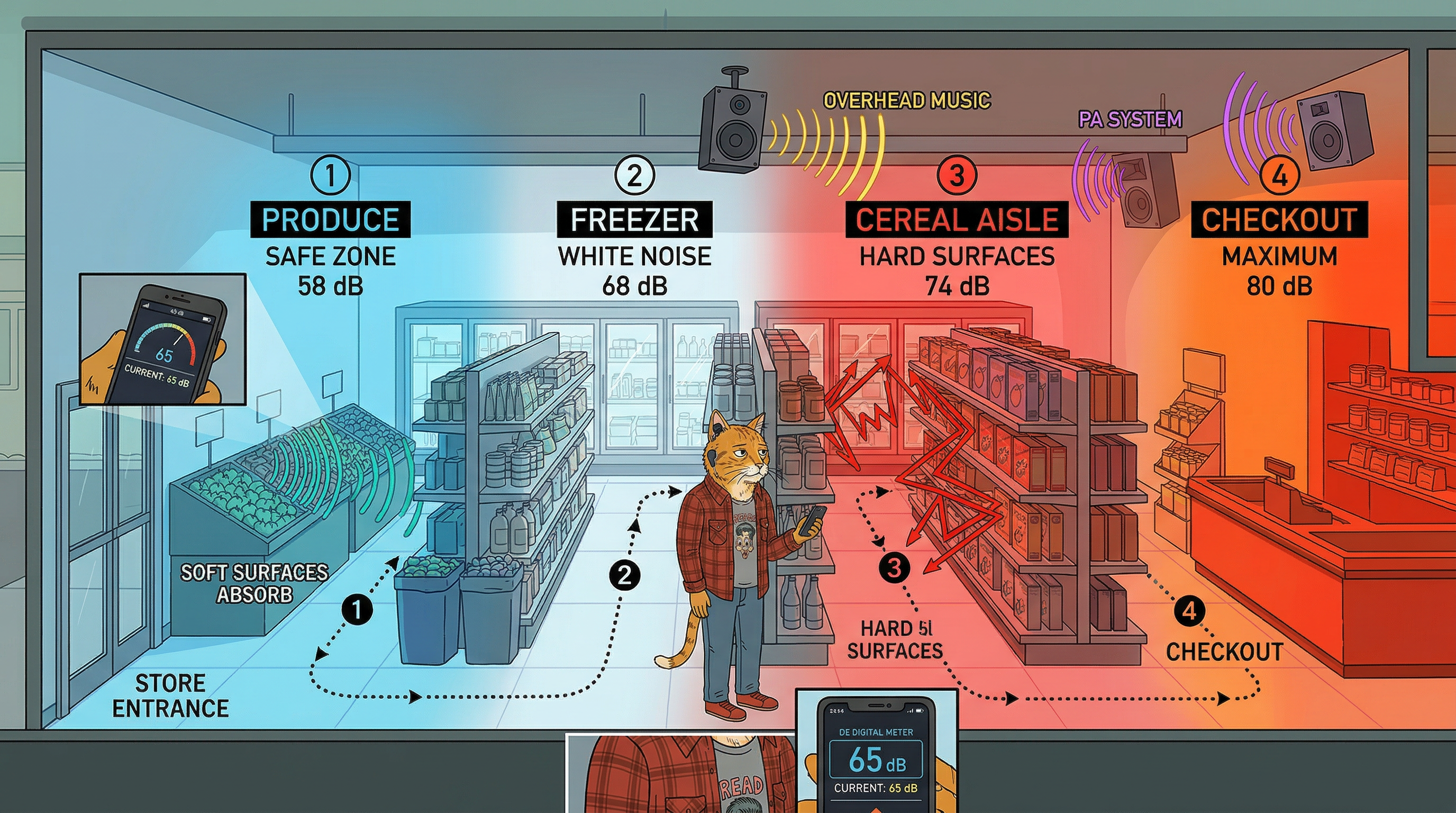
Grocery stores have distinct acoustic zones, and I've been navigating them by sound for decades without knowing I was doing it.
BACKGROUND:
I don't like grocery stores. This isn't preference. It's physiology. A grocery store is an acoustic environment designed for a brain that filters — that takes the aggregate sensory input of a 50,000 square foot retail space and compresses it into "store noise" and moves on. My brain doesn't compress. My brain receives the full uncompressed file, every frequency, every source, every reflection, and processes all of it simultaneously.
A grocery store, to me, is not one sound. It's a landscape.
I've been mapping it.
THE ZONES: Produce Section
Acoustic signature: soft. Dampened. The quietest zone in the store.
The produce section is almost always positioned at the entrance — this is standard grocery store design, something about fresh food creating a positive first impression. But the acoustic consequence is more interesting than the marketing strategy: produce is soft. Lettuce, tomatoes, bananas, avocados — these are sound-absorbing surfaces. The wooden crates and cardboard displays absorb mid-range frequencies. The misting system adds a low broadband hiss that functions as gentle white noise.
Measured sound level (phone app, approximate): 58-62 dB. For reference, a quiet office is 50 dB. The produce section is the quietest place in a building that is otherwise acoustically hostile.
The ceiling is usually higher here too. In Walmart, the produce section sits under the full warehouse ceiling — 20-25 feet. Sound disperses upward. The acoustic pressure drops. Your shoulders drop with it.
Bakery/DeliAcoustic signature: warm. Mid-range heavy. Moderate.
The ovens and display cases create a low mechanical hum — similar to the refrigerator problem, but spread across multiple units, which smooths the frequency peaks into something closer to broadband. The glass cases reflect high frequencies but absorb very little low end. The result is a zone that's warmer-sounding than produce but without the sharp edges of the harder aisles. 64-68 dB.
Cereal and Canned Goods AislesAcoustic signature: hard. Reflective. Echo-heavy.
This is where it gets bad. Cardboard boxes are rigid. Cans are metal. The shelving is steel. The floor is polished concrete or linoleum. Every surface in these aisles is a reflector. Sound doesn't absorb here — it bounces. Your footsteps echo. The overhead music is louder here, not because the speakers are closer, but because the surfaces are returning the sound instead of eating it. Another cart in the aisle creates a rattle-and-rumble that the hard surfaces amplify and sustain.
70-74 dB. And the quality of the sound is different — it's brittle. Sharp. The high frequencies that the produce section absorbed are fully present here, and they stack on top of the music and the PA system and the cart wheels and my own breathing, which gets faster in these aisles, which I didn't notice until I started paying attention.
Freezer SectionAcoustic signature: white noise. Glass and machinery.
The freezer section is an interesting case. The glass doors create a semi-enclosed acoustic space — when you open a door, the cold air rushes out with a broadband hiss, and the compressor units behind the cases generate a constant low drone that's louder than the refrigerator in the Super 8 but more consistent. Consistency is the key. A consistent sound, even a loud one, is easier to process than an inconsistent one. The freezer section is loud but predictable, and predictability is the closest thing my brain gets to quiet.
68-72 dB, but the subjective experience is calmer than the cereal aisle at the same level. Frequency consistency beats amplitude every time.
Checkout LanesAcoustic signature: maximum. The convergence point.
Everything concentrates here. The beeping of scanners — each one at a slightly different pitch, because different manufacturers, because of course I've noticed. The rustling of bags — plastic bags are acoustically violent, a broadband crinkle that contains frequencies from 2 kHz to 12 kHz, right in the range where the human ear is most sensitive. The music, which is loudest here because the speakers are positioned above the front end. The voices — compressed into narrow lanes, reflecting off hard surfaces, overlapping.
And the PA system. "Price check on register seven." At a volume calibrated for the entire store, fired directly into the narrow corridor where you're already at maximum input.
74-80 dB. The equivalent of standing next to a running vacuum cleaner. For a brain without a sensory gate, checkout is a controlled demolition of the sound floor you've been managing for the entire shopping trip.
THE ROUTE:
Here is how I shop. I've been doing this for years. I didn't know I was doing it until the identification.
1. Produce first. Always. Enter the store through the calm zone. The soft surfaces and the misting system give me an acoustic buffer — a few minutes at 60 dB to acclimate, to let the gate (such as it is) settle, to establish a baseline. 2. Freezer section second. Cross the store early, while the masking budget is full. The freezer section's white noise masks the store's ambient chaos. The consistent compressor drone functions like the truck engine — a known frequency that my brain can lock onto and use as a reference point. Shop the frozen goods while the white noise is doing its work. 3. Cereal and canned goods third. The hard aisles. Move fast. I don't browse here. I have a list. The list is not organized by category — it's organized by aisle, and the aisles are ordered by acoustic tolerance, not by store layout logic. Cereal, canned goods, cleaning supplies — every hard-surface aisle gets done in a single pass, fast, no stopping. 4. Checkout last. Obviously. But specifically: I choose the lane with the fewest people, even if it's slower. I choose self-checkout when available, because the scanner is one sound source I control. I bag my own groceries because the bag-rustling is less distressing when I control the rhythm.Then I leave.
THE REVELATION:
I didn't know I was doing this until the identification. I thought I just liked buying fruit first. I thought I preferred the freezer section because I liked frozen pizza. I thought I moved fast through the cereal aisle because I was "efficient."
I was routing around acoustic pain. Every grocery trip, for years, was an unconscious sensory management protocol. My brain built the route the way it builds everything — by pattern, by optimization, by finding the path of least resistance through a hostile landscape — and it did it so quietly that I thought it was preference.
It wasn't preference. It was survival. The brain that hears everything built a map through the store that minimized what it had to hear, and it never told me what it was doing.
HYPOTHESIS:
Grocery stores are designed for neurotypical acoustic tolerance. The speaker placement, the music volume, the arrangement of hard and soft surfaces — all of it optimized for a brain that filters. The produce at the entrance isn't just marketing. It's an acoustic welcome mat that works because most people's brains use those few soft minutes to calibrate their filters for the harder zones ahead. The store is already doing sensory management. It's just doing it for a different brain.
My brain needs a different route through the same store. The data supports this. The produce section is measurably quieter. The freezer section's white noise is measurably more consistent. The hard aisles are measurably more reflective. I'm not imagining the landscape. The landscape is real. I'm just the only one in the store who's reading it.
PRACTICAL APPLICATION:
If you're autistic and you hate grocery shopping and you don't know why: measure the sound. Walk the store with a decibel meter app. Map the zones. Find your route. It might not be my route — your sensory profile is yours, not mine — but there IS a route, and your brain may have already built it for you without telling you.
Also: noise-canceling earbuds. I resisted these for years because they felt like cheating. They're not cheating. They're the manual version of the gate that other people's brains run for free. Use the tools.
STATUS: Observed. Data consistent across 8 Walmart locations, 3 Krogers, and 2 regional chains. Produce is always the quietest zone. Checkout is always the loudest. The middle varies by store layout, but the hard-aisle-to-freezer-section pattern holds. PERSONAL NOTE:
I'm sitting in the Walmart parking lot in Tulsa. The groceries are in the truck. The trip took 22 minutes, which is 8 minutes faster than the average American grocery trip according to a study I read once and filed permanently because my brain doesn't delete data, it just archives it in increasingly specific folders.
The truck is idling. 1400 RPM. The sound floor is mine again. The grocery store is behind me, and the grocery store was loud, and now it's not, and the engine is humming at a frequency I chose, and the parking lot is quiet the way parking lots are quiet — not actually quiet, but quiet compared to what I just walked through.
I didn't know I was doing any of this until I was fifty years old. Fifty years of optimized grocery routes and I thought I just liked fruit.
The brain is the funniest machine I've ever operated. And I operate a truck.
Next time: Cab Note #005 — on rest area architecture, and why every rest area in America is designed like a question nobody finished asking.