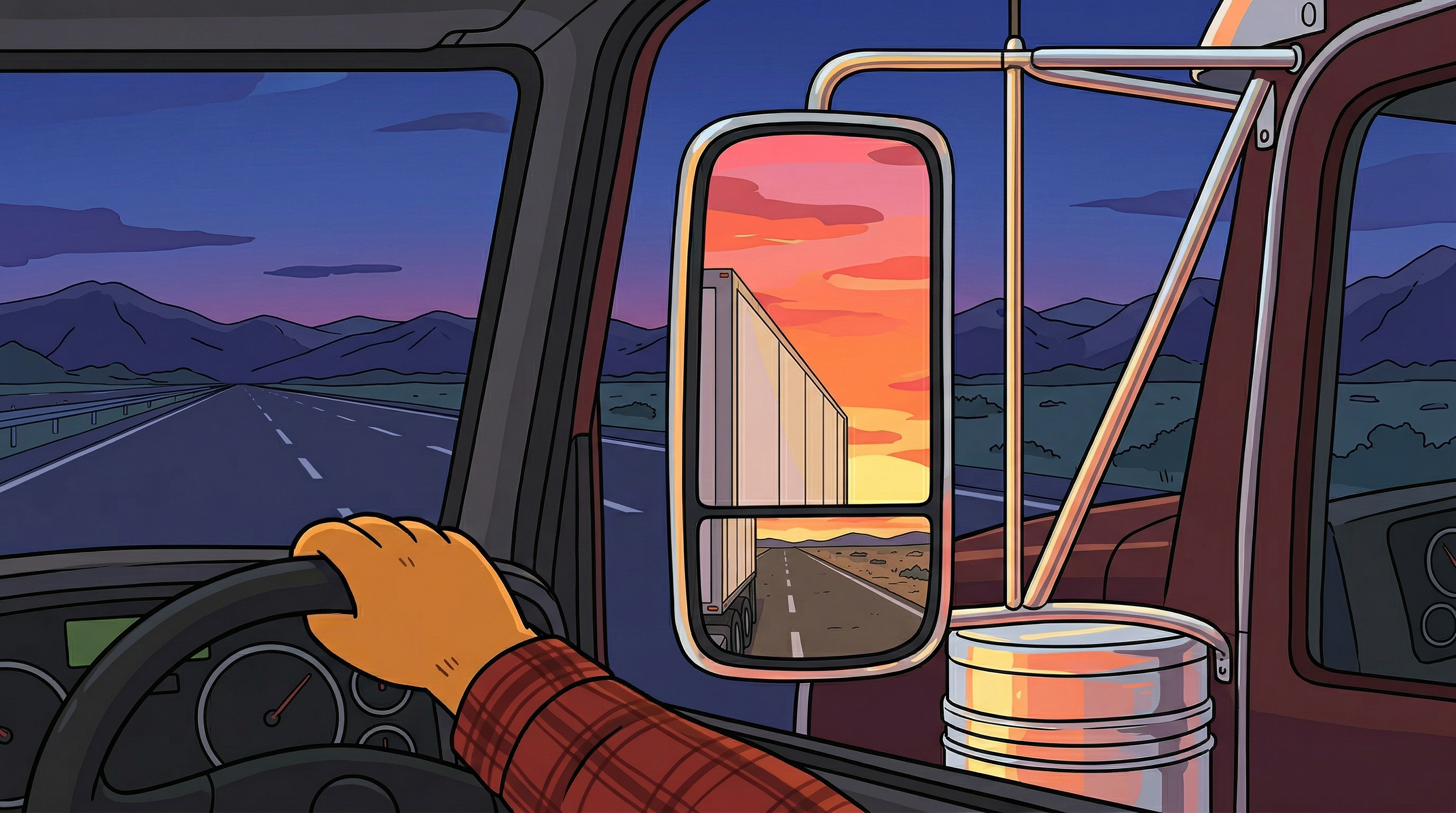
Every small town in Kansas has the same DNA.
I don't mean they look similar. I mean they are, structurally, the same town. They are variations on a single organism. The way every snowflake is hexagonal but no two are identical — every small Kansas town is the same town wearing different paint.
Here is the town:
There is a Main Street. It is three to seven blocks long. It contains: a bank (local, one branch), a diner or cafe (breakfast all day), a hardware store or a general store (increasingly likely to be closed), a bar (one, sometimes two), a church (at least two, usually Baptist and Methodist, sometimes Catholic depending on the immigration history), a post office, and a building that used to be something and is now either an antique store or empty.
There is a grain elevator visible from the highway. It is the tallest structure. It is more architecturally significant than anything else in town, not because anyone designed it to be, but because function creates form and the function of storing grain at scale produces a structure that looks, from a distance, like a cathedral.
There is a water tower with the town name on it. There is a school. There is a park with a war memorial. There is a street grid that makes perfect sense from above and no sense from inside because half the streets don't connect to anything anymore.
I have been to Russell, Kansas, and WaKeeney, Kansas, and Oakley, Kansas, and Hays, Kansas, and Ellsworth, Kansas, and Salina, Kansas, and Wilson, Kansas, and Lucas, Kansas, and Plainville, Kansas, and Stockton, Kansas, and Osborne, Kansas, and Smith Center, Kansas, and Phillipsburg, Kansas.
They are the same town.
There's a word for this. The word is synecdoche — when a part represents the whole. A hand waving from a ship represents the entire person. A crown represents the entire monarchy. Russell, Kansas, represents every small town in Kansas, which represents every small town in America, which represents something about how humans organize when left alone with flat land and grain.
I once saw a movie — or a trailer for a movie, or a description of a movie, I can't remember which because my memory files things by location and I can't remember where I was when I encountered this — about a man who builds a scale replica of New York City inside a warehouse, and then builds a replica of the warehouse inside the replica, and the replicas go deeper and deeper and the man gets older and the city gets bigger and the point is either that art consumes the artist or that every attempt to represent reality creates a new reality that also needs representing.
I think about that a lot. Driving through Russell, Kansas, and thinking: this town is a representation of a town. The Main Street is a synecdoche for Main Streets. The grain elevator is a synecdoche for agriculture. The diner is a synecdoche for community. The empty building is a synecdoche for decay.
And I — passing through, cataloging, filing, mapping — am building a representation of the representation. My pattern log of Kansas towns is a model of the model. And this blog post about the pattern log is a model of the model of the model.
At some point, the nesting has to stop. Or does it? Does it ever stop? Is there a bottom layer, or does every representation generate another representation, all the way down, until the man building the warehouse inside the warehouse inside the warehouse finally runs out of room?
I think the answer is: the man runs out of time before he runs out of layers.
This is what my brain does. It finds the pattern (Kansas towns are the same town). Then it finds the pattern in the pattern (the sameness reflects resource distribution). Then it finds the pattern in THAT (resource distribution is fractal). Then it finds the pattern in THAT (fractal distribution means every part contains the whole). Then it finds the pattern in —
And I'm sitting in a diner in Russell, Kansas, at 7 PM on a Tuesday, staring at my coffee like it contains the answer to something, and the waitress asks if I want a refill and I say yes without looking up because I'm four layers deep in a recursive observation about the nature of representation and honestly the coffee is a synecdoche for the entire experience of being a human who can't stop zooming out.
The practical version of this — the part that might be useful to someone who isn't four layers deep in a Kansas diner:
Autistic pattern recognition doesn't stop at the first pattern.Neurotypical pattern recognition (as far as I can tell from the outside): observe, identify pattern, file, move on. The pattern is a conclusion. You find it and you're done.
Autistic pattern recognition: observe, identify pattern, identify the pattern in the pattern, identify the pattern in THAT, continue recursing until external stimulus interrupts or exhaustion intervenes. The pattern is not a conclusion. It's a door. And behind every door is another door.
This is why autistic people get lost in things. Not because we can't pay attention — because we can't stop paying attention. The attention recurses. The observation observes itself. The town contains the town contains the town.
Some people call this "getting stuck." I call it "going deep." The difference is whether you think depth has value.
I've been to Russell, Kansas, six times. Different loads, different routes, different seasons. It's the same town every time. The same diner. The same grain elevator. The same DNA expressing itself in the same configuration.
But here's the thing that keeps me coming back (figuratively — I come back literally because dispatch sends me):
It's ALSO different every time. The same town, but the light is different. The same Main Street, but the antique store changed its window display. The same grain elevator, but the wheat is a different height. The same pattern, but the variables have shifted.
Same structure. Different expression. Like a song covered in another language.
The town is the same. The town is different. Both are true. That's the synecdoche — the part that contains the whole also contains every possible version of itself.
Russell, Kansas, is every town I've ever driven through. And every town I've ever driven through is Russell, Kansas. And this blog post is a map of the map of the map, and the coffee is cold, and the waitress is coming back, and somewhere outside the grain elevator is doing its impression of a cathedral, and the pattern goes deeper, and the pattern always goes deeper, and at some point you just have to drink the coffee and drive.
Next time: The Eye Contact Equation — a precise mathematical model for how much eye contact is required in different social contexts, presented as though this is a normal thing to have calculated.