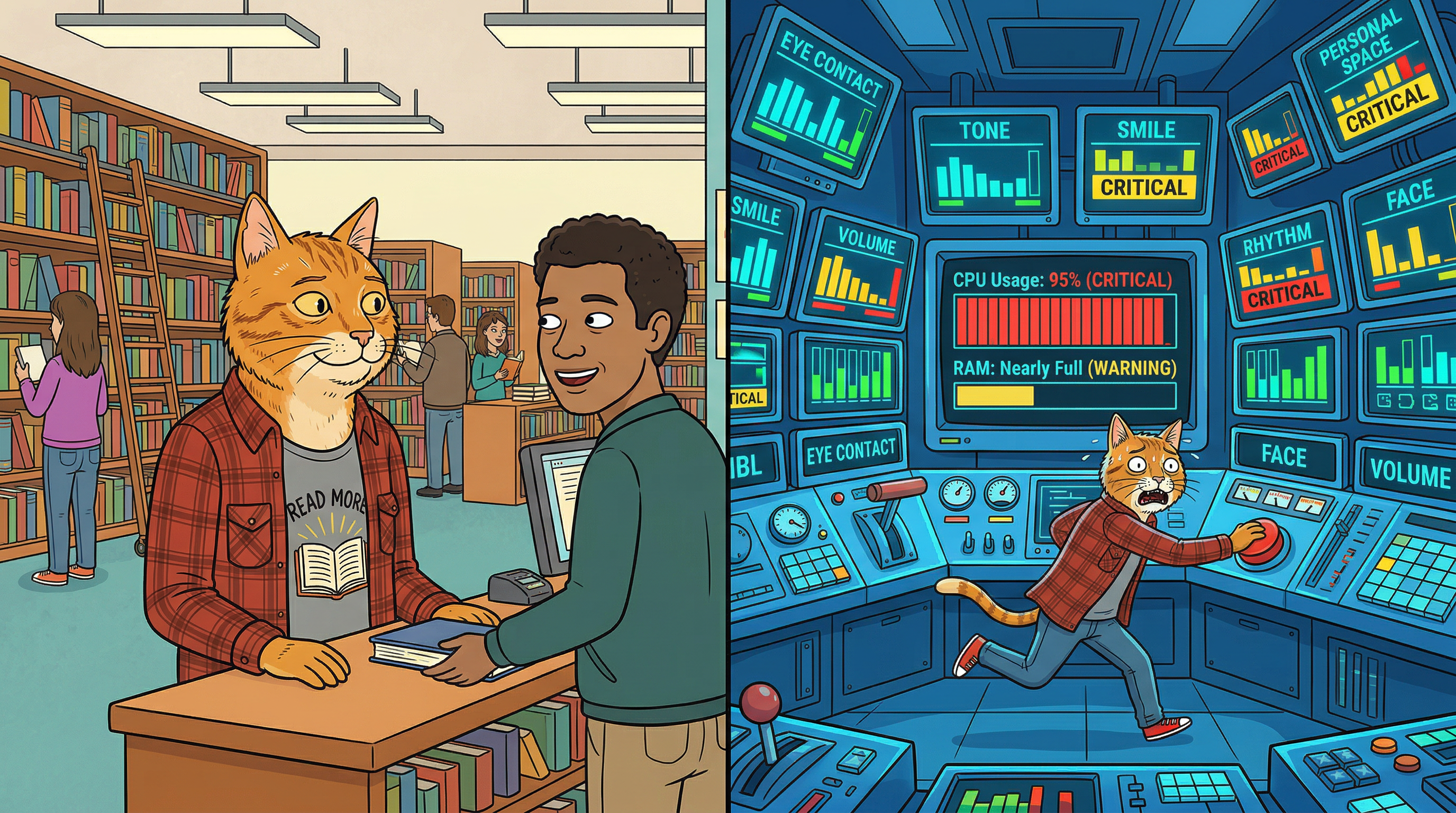
Imagine your brain is a computer. Not metaphorically. Functionally.
Every brain runs processes. Breathing. Balance. Language. Emotion. Social awareness. Most of these run in the background — you don't have to think about breathing, your system handles it. A neurotypical brain runs social interaction the same way. Reading faces, modulating tone, maintaining eye contact, tracking conversational rhythm, managing personal space, performing appropriate emotional responses — all of it runs automatically, below conscious awareness, like an operating system handling drivers.
My brain does all of this manually.
Every single one of those processes — the eye contact, the tone, the face, the rhythm, the space, the response — runs as a conscious subroutine. Not in the background. In the foreground. Taking up RAM. Drawing from the same processing power I need for thinking, speaking, working, and staying upright.
That's masking. That's what masking actually is. It's not deception. It's not performance. It's running forty manual processes simultaneously that your brain runs automatically, and hoping the system doesn't crash before the conversation ends.

On a good day — rested, fed, calm, uneventful life — the subroutines run fine. There's enough processing power to handle the mask AND think AND work AND be a person. It's expensive, but manageable. Like a computer running a dozen browser tabs. Each one costs something, but the system holds.
This is why people who meet me on a good day think I'm charming. Engaged. Funny. Maybe a little intense but in a way that reads as passionate. They're meeting me at full processing capacity with all subroutines running clean. They have no idea what it costs.
On a bad day — tired, stressed, grieving, overwhelmed, too many demands from too many directions — the resource budget collapses. The system can't run forty subroutines AND handle the crisis AND maintain the mask. Something has to give.
The mask gives first.
Not all at once. One subroutine at a time. Eye contact drops. Tone flattens. Facial expressions stop updating. Conversational rhythm breaks. I start responding a half-beat late, or not at all. The processes shut down in order of priority, the way a computer in power-save mode kills background apps one by one to keep the core system running.
The people around me don't see subroutines shutting down. They see a man becoming cold. Distant. Difficult. They think something changed in how I feel about them. Nothing changed. The system ran out of resources and started shedding load.
THE CLEVER ONES:
Here's what research is beginning to catch up with:
The higher the cognitive capacity, the less likely you are to be diagnosed.
Think about that. The smarter you are, the better you mask. The better you mask, the more invisible the autism becomes. The more invisible it is, the later the diagnosis. The later the diagnosis, the longer you spend thinking you're broken instead of understanding you're running a different operating system.
If I had been diagnosed at the same age kids get diagnosed now, it would have been in the early 1980s. Autism had barely been added to the DSM. Nobody knew what it looked like in a kid who could talk, who could read, who could pattern-match well enough to pass. Nobody was looking for the kid who seemed fine because the kid who seemed fine was working harder than anyone in the room to seem fine.
We were like little AIs that escaped containment without noticing. Clever pattern-matching machines that recognized, at a preverbal level, that deviation from the pattern meant ostracization. Potentially worse. The survival mechanism wrote itself before we were old enough to know it was running: observe the pattern, match the pattern, do not deviate, do not attract attention, stay alive.
You do something for thirty years and it becomes second nature. You forget it's not first nature. You forget there's a you underneath the subroutines, because the subroutines have been running so long they feel like personality. You know something's wrong. You know something is slowly consuming resources you can't replenish. You know you're tired in a way that sleep doesn't fix. But you can't name it, because the thing that's killing you is the thing that's keeping you alive.
I don't blame my parents for missing it. I don't blame the teachers or the doctors or the coaches. We were invisible by design — our own design, executed before we had the language to consent to it. They weren't negligent. We were too good at the one thing that made us impossible to find.
THE EXPECTATION:
And then one day you figure it out.
You read an article. You watch a video. You take a test. You talk to someone who describes your inner life back to you with a precision that makes your chest tight. And the diagnosis — or the self-recognition, because not everyone gets the piece of paper — arrives like a software update that explains every bug you've ever filed against yourself.
Oh. The social exhaustion. The sensory events. The friend expiration dates. The fiberglass brain. The pattern obsession. The way I've been running my life like a control room managing forty monitors when everyone else is watching one screen.
And the immediate, well-meaning response from every article and every therapist and every support group is: you need to unmask.
Just stop. Take off the mask. Be yourself.
And I'm like — beg your fucking pardon?
YOU CAN'T JUST STOP:
Can you just stop breathing?
That's what it feels like. Not because masking is natural — it isn't. Because it's been running for so long that it's embedded in the operating system at a level I don't have admin access to. The subroutines don't have an off switch. They have forty years of reinforcement, forty years of "this is how you survive," forty years of proof that unmasked behavior makes people uncomfortable, makes them leave, makes them look at you the way they look at a thing they don't understand and don't want to.
When I don't mask, it makes people uncomfortable. Me the most.
I don't know what my face does when it's not being managed. I don't know what my voice sounds like when it's not being modulated. I don't know what my body does when it's not being directed. I have seen glimpses — in moments of extreme fatigue, extreme comfort, extreme distraction — and what I've seen is a person who moves differently. Speaks differently. Occupies space differently. Not wrong. Not broken. But different in a way that people notice and can't name and respond to with the low-grade unease of someone who senses the pattern has been broken.
I'm not masking to trick you. I'm not hiding some horrible secret behind the subroutines. I just want you to feel comfortable in my presence. I just want to be someone you can sit next to without your nervous system sending you signals that something is off about the man to your left.
The problem is that the mask is killing me and the absence of the mask makes you uncomfortable and I don't know where the balance is. I know it exists. I know there's a place between "full performance" and "fully unmasked" where I can be honest about what I am without making everyone in the room recalibrate their expectations of human behavior.
I just haven't found it yet. I'm working on it. I've been working on it for about two years, since I figured out what the mask was. Progress is slow because the subroutines resist modification. They were written to protect a child. They don't understand that the child is forty-nine and the threat model has changed.
THE PARADOX:
The mask is the thing that made me invisible. The mask is the thing that kept me safe. The mask is the thing that cost me a diagnosis for forty years. The mask is the thing that's exhausting me to death. The mask is the thing I can't remove without consequences I'm not sure I can afford.
The mask saved my life and is ruining my life and I built it before I knew what I was building and now I have to renovate it while I'm living in it.
That's not a metaphor. That's Tuesday.
THE BALANCE:
I don't have an answer yet. I have a direction.
The direction is: selective honesty. Not unmasking for everyone. Not performing for everyone. Finding the people — the small number, the ones who passed Phase 4, the ones who stayed — and letting the subroutines go quiet around them. One at a time. Eye contact first. Then tone. Then the face. Letting each process return to automatic — or shut down entirely — and seeing if the person across from me can handle the version of me that appears when the processes aren't running.
Some can. Some can't. The ones who can't aren't bad people. They're people whose pattern-matching works fine and my unmasked presence breaks their pattern. That's not their fault. It's not mine either.
The ones who can — who sit with the unmodulated voice and the unmanaged face and the different rhythm and don't flinch — those people are my crew. Those people are the ones I build ships for.
I'm working on it. I'm finding the balance. I'm learning to let the subroutines go idle, one at a time, with the people who can hold the space. It's slow. It's uncomfortable. It feels like learning to breathe a different way after forty years of breathing the only way I knew.
But the system can't keep running at this capacity. Something has to change. Either I find the balance, or the system crashes, and I don't get to choose which subroutines survive the reboot.
I'd rather choose.
< cab radio: Sierra Ferrell, then silence, then something he hasn't heard yet >
Next time: something lighter. Maybe. Probably not. But I'll try.
He puts his library badge back on and walks to the circulation desk. A patron approaches with a question about interlibrary loans. He smiles. The smile costs one subroutine. The eye contact costs another. The modulated customer-service voice costs a third. Three processes, spinning up like fans in a computer under load. The patron doesn't hear the fans. Nobody ever hears the fans. They just see the library assistant. Helpful. Friendly. A little intense, maybe, but in a good way. They have no idea what it costs. He has no idea what it would cost to stop.