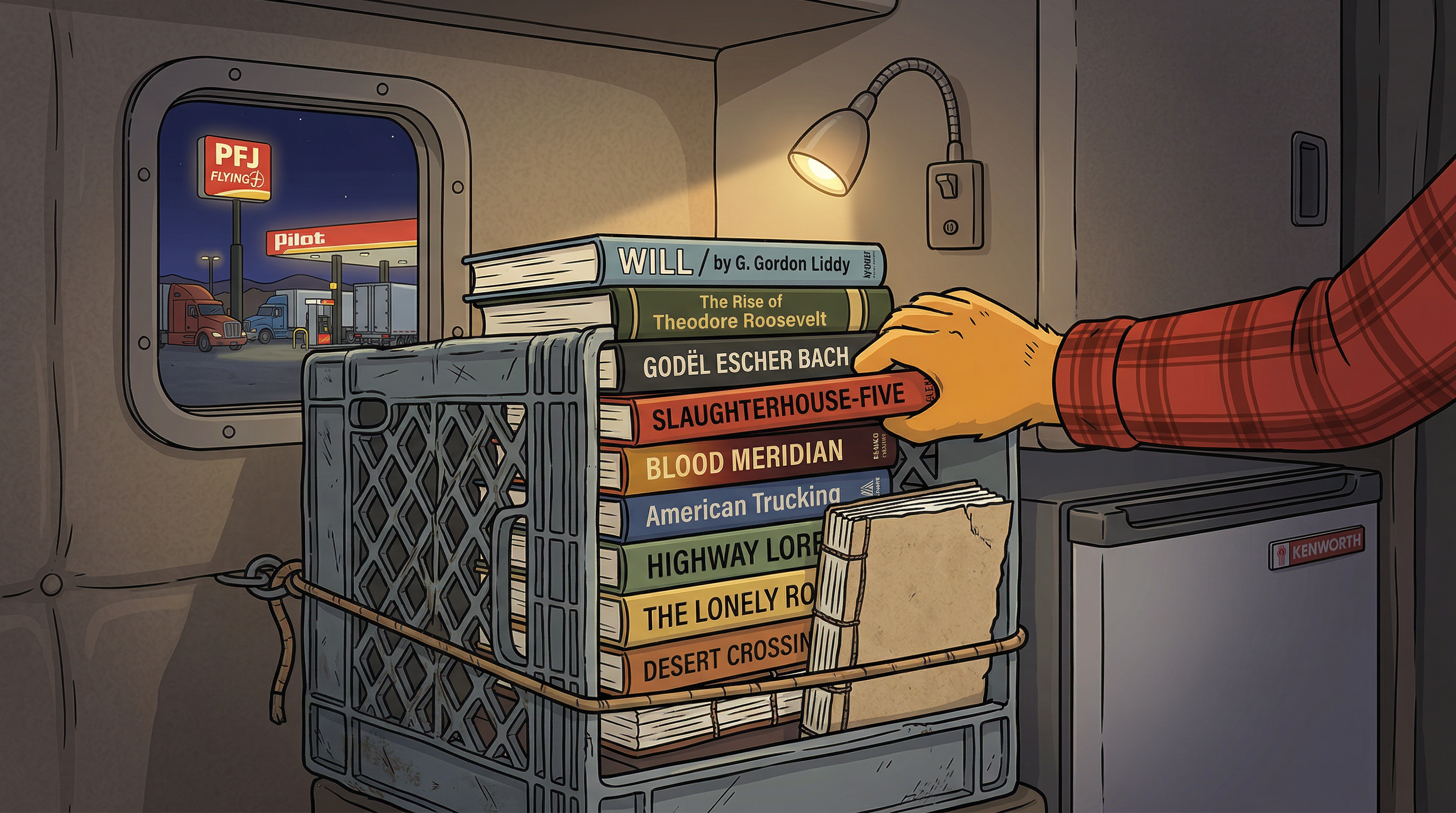
I carry a milk crate of books in the cab. Gray plastic. The kind you steal from behind a grocery store, which I did, in 2009, from behind a Kroger in Memphis, and I mention this because I believe in being honest about the origins of load-bearing infrastructure.
The crate holds between eight and twelve books, depending on thickness. It sits behind the passenger seat, wedged between the wall and the mini fridge, secured with a bungee cord that I replace every six months because UV degrades rubber and the last thing I need is a crate of books projectile-launching into the back of my head during a hard brake.
The books rotate. Every truck stop with a used book section — and I have mapped them, because of course I have — is a potential swap. Drop one, grab one. The crate is a living library with a population that turns over every three to four weeks.
I've been running this system for over fifteen years. The crate has held an estimated 2,500 books. I haven't kept a list. My brain is the list, and the list is organized by geography.
A PARTIAL TAXONOMY OF TRUCK STOP BOOK SECTIONS ACROSS AMERICA: The Southern Corridor (I-10, I-20, I-40 through Texas, New Mexico, Arizona):
The book sections down here run hot. Military thrillers. Westerns. True crime. The Tom Clancy-to-Louis L'Amour pipeline is real and it is robust. You will find: every Jack Reacher novel, multiple times. Every John Grisham from the '90s. At least two copies of The Da Vinci Code at every stop. A surprising amount of Cormac McCarthy — not Blood Meridian, always The Road or No Country for Old Men, because the movie versions created demand for the books.
The hidden gem tier: once in a while, between the Clancys and the L'Amours, you find something that has no business being there. A copy of Gödel, Escher, Bach at a Love's outside Deming, New Mexico. The Structure of Scientific Revolutions at a Petro in Van Horn, Texas. Someone's personal library, donated or abandoned, and a single book from a different universe has ended up on a shelf next to Patriot Games.
I found Gödel, Escher, Bach at that Love's in 2016. It's a book about the patterns that connect mathematics, art, and music — about how self-referential systems create meaning, about how consciousness might emerge from recursive loops. It's also 777 pages long and I read it in three days on a run from El Paso to Jacksonville.
It changed how I think about everything. And I found it between a James Patterson and a Danielle Steel, in a truck stop in a town of 14,000 people, in the middle of the Chihuahuan Desert.
Books find you. I believe this. I have no evidence. I believe it anyway.
The Midwest Corridor (I-70, I-80 through Kansas, Nebraska, Iowa):The Midwest book sections are practical. Farm memoirs. Weather guides. Regional history — county-specific, deeply local, the kind of book that sells 200 copies and every copy ends up at a truck stop or an estate sale. You will find: cookbooks from churches you've never heard of. Self-published novels about farming families. Chicken Soup for the Soul, all editions, in quantities that suggest a manufacturing defect rather than consumer demand.
But the Midwest also has the best science sections. I have a theory about this: the land is flat, the sky is visible, and people who live under a visible sky think about the universe more. The Pilot in Salina, Kansas, regularly stocks popular physics — Hawking, Sagan, Tyson. The TA in Grand Island, Nebraska, had a copy of Cosmos with Carl Sagan's signature in it. I cannot confirm the signature was real. I can confirm I sat in the parking lot for forty-five minutes holding it like it was a religious artifact.
The Northeast Corridor (I-95, I-81 through Virginia, Pennsylvania, New York):The most literary truck stop sections in America. Probably because the Northeast has more used bookstores per capita feeding the pipeline. You find actual literature here — not just genre fiction, but Steinbeck, Hemingway, Vonnegut. The I-81 corridor through Virginia is particularly good. The Petro in Wytheville almost always has something worth taking.
I found Slaughterhouse-Five at a rest area on the Pennsylvania Turnpike. Vonnegut writes like an autistic person who learned to be funny about it — flat affect, precise observations, the emotional payload hidden inside the deadpan delivery. "So it goes." The most autistic three words in American literature. The acceptance of what cannot be changed, delivered without sentiment, repeated until it becomes a mantra.
I've read Slaughterhouse-Five four times. Each time at a different location. Each location is a different book.
The Pacific Northwest (I-5, I-84 through Oregon, Washington):The weirdest sections. The Pacific Northwest truck stops stock things that shouldn't exist in a commercial travel center — anarchist zines, self-published poetry, books about mushroom identification that are either field guides or philosophy depending on your reading. Portland's influence radiates outward. Even the Flying J outside Salem has a vaguely countercultural energy to its book shelf.
I found a hand-bound chapbook at a rest area on I-84 outside The Dalles. No author name. Just a collection of short essays about libraries — how they function as architecture, how the organization system IS the philosophy, how a library is the physical manifestation of a culture's relationship to knowledge. Forty pages. Hand-stitched spine. Someone made this by hand and left it on a shelf next to a Louis L'Amour.
I still have it. It's the only book that hasn't rotated out of the crate. Fifteen years, and it stays.
WHAT THE CRATE TAUGHT ME:
The crate is not a library. A library is organized. The crate is an ecosystem — books entering and leaving based on availability, proximity, and whatever the truck stop gods have decided to provide.
This means I don't choose what I read. Not really. I choose from what's available, and what's available is random. A military thriller next to a physics textbook next to a romance novel next to a philosophy of libraries chapbook. No curation. No algorithm. No "readers who bought this also bought." Just whatever ended up on the shelf.
And here's what I've learned from twenty years of reading without curation:
Everything connects.Not in a mystical way. In a structural way. The military thriller uses the same narrative tension patterns as the romance novel. The physics textbook describes the same recursive systems as the philosophy chapbook. The Cormac McCarthy uses the same landscape-as-character technique as the farm memoir. When you read without categories, you see the architecture that all writing shares — the load-bearing walls that hold up every story regardless of genre.
Pattern recognition. Even in the crate. Especially in the crate.
The crate is behind me right now. Current inventory, Tucumcari, New Mexico, March:
1. The Unbearable Lightness of Being — Milan Kundera (picked up in Amarillo) 2. A Short History of Nearly Everything — Bill Bryson (picked up in Oklahoma City) 3. Blood Meridian — Cormac McCarthy (finally, picked up in Albuquerque) 4. The Mushroom at the End of the World — Anna Lowenhaupt Tsing (picked up in Portland, obviously) 5. Will — G. Gordon Liddy (this one doesn't rotate. This one stays.) 6. A Roosevelt biography — Edmund Morris, The Rise of Theodore Roosevelt (this one doesn't rotate either.) 7. Gödel, Escher, Bach — Douglas Hofstadter (doesn't rotate. The Love's in Deming book.) 8. The chapbook about libraries. (Never rotates. Never will.) 9. A trucker's guide to engine maintenance, 2003 edition. (Reference material.) 10. Slaughterhouse-Five — Vonnegut. (Fourth copy. Different location. Different book.)
Three permanent residents. Seven rotating guests. One stolen milk crate. Fifteen years and counting.
The engine is doing the cooling song. The book I'll read tonight is whichever one my hand touches first. That's the system. That's always been the system.
The crate provides. I receive.
Next time: Cab Note #003 — on the specific loneliness of being the smartest person in a room who can't prove it and doesn't want to.