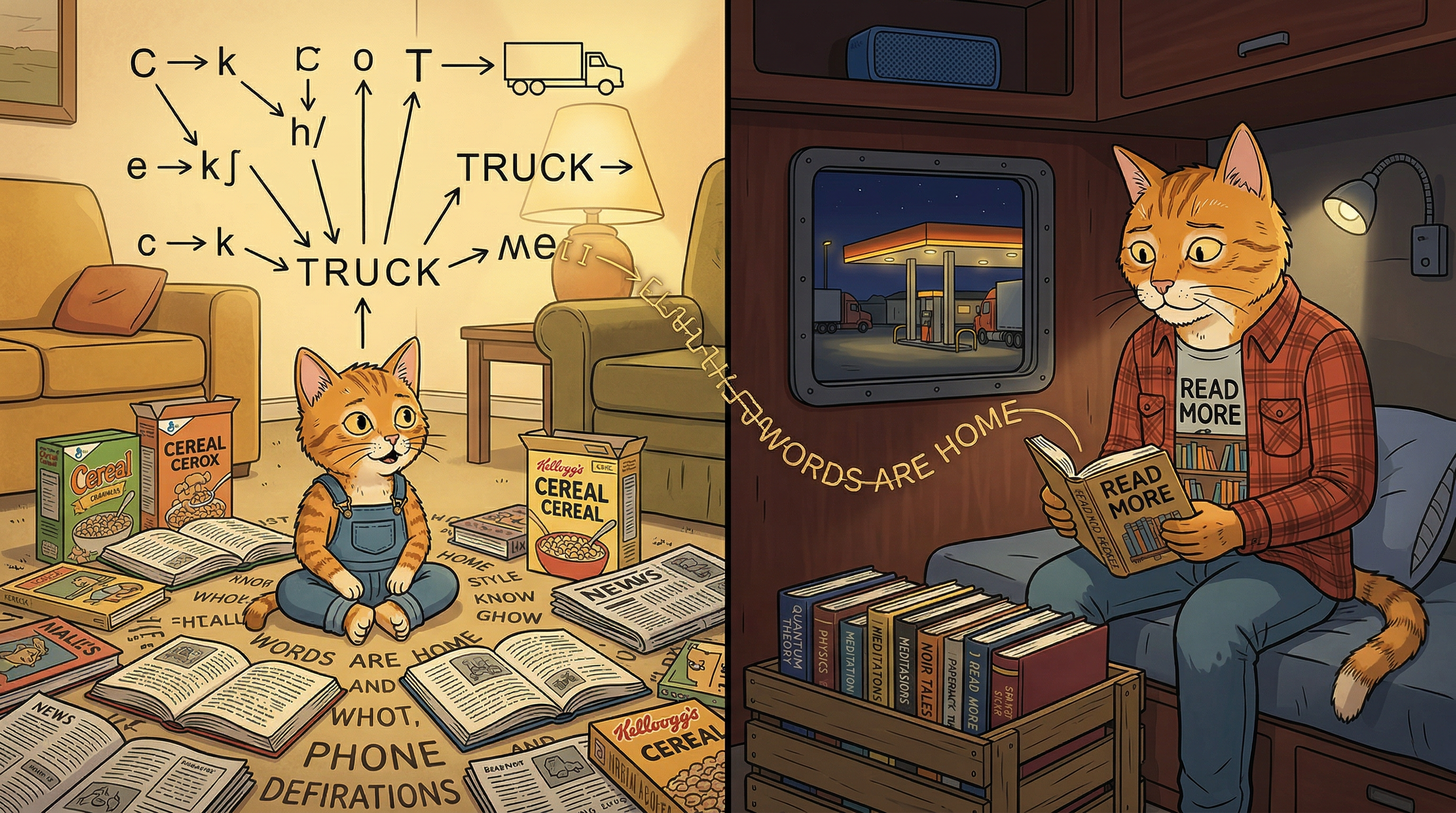
I was three years old when I started reading.
I want to be specific about what I mean by that, because "my kid is reading at three" is a thing parents say that usually means the kid has memorized some words or can recite a picture book from memory. That's not what I mean.
I mean I could decode text. Any text. Hand me a cereal box, a road sign, a newspaper, a book I'd never seen — I could sound out the words, understand what they meant, and keep going. Not because someone taught me. Because I'd figured out the system.
Letters are symbols. Symbols represent sounds. Sounds combine into words. Words have meanings. Meanings combine into sentences. I understood this the way you understand that a light switch controls a light — mechanically, obviously, as a system with inputs and outputs.
What I didn't understand was that this was unusual.
Here's the part that still makes me laugh, thirty-something years later:
I didn't know I was reading.
I knew what "reading" was — adults talked about it constantly. "Time to practice your reading." "Reading is important." "When you learn to read, a whole world opens up." But whatever they were describing sounded like something on top of what I was already doing. Something extra. Some higher-level skill that would be unlocked later.
Because I already knew how to decode words. That part was done. That was just... looking at things and understanding them. That wasn't "reading." Reading was something bigger, something harder, something that required instruction and practice and the kind of serious adult attention that suggested a meaningful challenge.
So I sat in class, waiting to learn this "reading" thing, already doing it, not realizing the thing I was waiting for was the thing I was already doing.
I was waiting for the lesson about the skill I'd already taught myself.
If there is a more autistic sentence in the English language, I have not encountered it.
The clinical term is hyperlexia. It means: advanced reading ability that appears significantly before it's expected, usually without formal instruction. It's associated with autism. Not all hyperlexic kids are autistic, and not all autistic kids are hyperlexic, but the Venn diagram has a fat middle.
Here's what the clinical definition misses:
Hyperlexia isn't just "reading early." It's a specific relationship with text — with symbols, with encoded meaning, with the system of turning marks on a surface into thoughts in a brain. The reading isn't a skill I developed. It's a mode of perception. Text isn't something I decode. It's something I see. The way you see a face and immediately recognize it as a face without having to analyze each feature — that's how I see text. Whole. Instant. Structural.
This has consequences.
Consequence 1: I read everything.
Not recreationally. Compulsively. Every sign, every label, every menu, every bumper sticker, every piece of text in my visual field gets processed whether I want it to or not. Walking through a truck stop is a data torrent — brand names, nutritional information, safety warnings, bathroom graffiti, the fine print on the fuel pump, the handwritten "OUT OF ORDER" sign on the third stall. All of it goes in. None of it is filtered.
This is pattern recognition's origin story. The reading came first. The patterns came from the reading. When you've been decoding systems since you were three, the whole world starts to look like text — structured, symbolic, waiting to be read. The highway is text. The weather is text. The floor tiles at the Love's in Knoxville are text. You just have to know the alphabet.
Consequence 2: I was never taught to read, so I was never taught to read "correctly."There's no teacher in my history who shaped my reading habits, because by the time teachers got to me, I was already done. This means I read without the filters that formal instruction installs. I don't skim. I don't prioritize. I don't read "for the main idea." I read everything at the same resolution — the footnotes get the same attention as the title. The terms and conditions get the same attention as the headline.
This is a superpower in a truck cab at 2 AM with nothing to read but the owner's manual. It is a disability at a dinner party where someone hands you a menu and expects you to order in under three minutes and you're still on page one because you're reading the sourcing disclosure for the chicken.
Consequence 3: Books are not entertainment. Books are architecture.When I read a book, I'm not experiencing a story. I'm disassembling a machine. How is this sentence built? Why this word and not that one? What's the rhythm of this paragraph? Where's the load-bearing wall in this chapter? Every book is a building, and I walk through it checking the structure.
G. Gordon Liddy's Will — the book that gave me the feedback machine idea — I read that in fourth grade. Not because I was advanced (though technically I was). Because it was on a shelf and I read what was on shelves. I read it the way I read everything: structurally. And the structure I found was: fear is a system. Systems can be reverse-engineered. Reverse-engineering requires direct confrontation with the inputs.
A normal kid reads Will and gets a story about a tough guy. I read Will and got an engineering manual. Because that's what hyperlexia does — it turns text into blueprints.
Consequence 4: Writing is just reading in reverse.If you've been decoding systems since you were three — taking symbols apart, understanding how they connect, seeing the architecture of meaning — then creating those systems is the obvious next step. Writing isn't a separate skill from reading. It's reading played backward. You understand the machine, so you build machines.
This blog exists because I was hyperlexic. Every sentence I've ever written exists because a three-year-old looked at symbols on a page and his brain said: I know what this is. This is a system. I can see the system.
Thirty-some years later, the system is still the most comfortable place I know. More comfortable than people. More predictable than social interaction. More legible than faces.
Text doesn't require eye contact. Text doesn't need the social preamble. Text says what it means and means what it says, and if it doesn't, you can reread it until it does, at your own speed, in your own silence, without anyone watching your face to see if you're reacting correctly.
I should probably tell you about the reading in the truck.
Every cab I've driven has had a crate. The crate contains: books. Usually six to ten at a time, rotated at truck stops that have used book sections (not all of them do, and I have them mapped — which ones have books, what kind of stock, how often it turns over. Yes. I mapped this. Pattern recognition doesn't take days off.).
The books are everything. History, science, philosophy, fiction, technical manuals, whatever the truck stop had that I haven't read. No hierarchy. A paperback thriller gets the same structural attention as a physics textbook. A biography of a president gets the same attention as a trucker's guide to engine maintenance.
The podcast thing came later. The podcasts are for driving — audio information for when my eyes are on the road. The books are for the stops. For the rest areas and the truck stops and the parking lots at 2 AM when the engine is doing the cooling song and my brain needs text the way other people need food.
I've estimated — conservatively, based on average reading speed and available downtime — that I've read approximately 2,500 books in the truck. Give or take a couple hundred. I don't keep a list. The books are filed in my head by location, same as the podcasts. "That's the one about Roman aqueducts. That was the TA in El Paso." "That's the thermodynamics book. That was a weigh station outside Boise."
My brain is a library organized by geography instead of genre.
When I was three, I looked at letters and saw a system.
When I was ten, I read a book and built a machine from its blueprints.
When I was twenty-three, I got in a truck with a crate of books and drove across America reading everything and understanding nothing about myself.
When I was fifty-something, I found out the word for what I am and realized the reading was the first symptom. The first evidence. The first time my brain showed me what it was — a pattern-recognition engine with a permanent hunger for encoded meaning.
The identification didn't start with the videos or the screening tools. It started with a three-year-old sitting on a floor, looking at marks on a page, and thinking:
When do we get to this reading thing? I already know how to do this part.We were already there, kid. We were always already there.
Next time: The Crate — a taxonomy of truck stop book sections across America, and what a rest area's reading selection tells you about the region's soul.