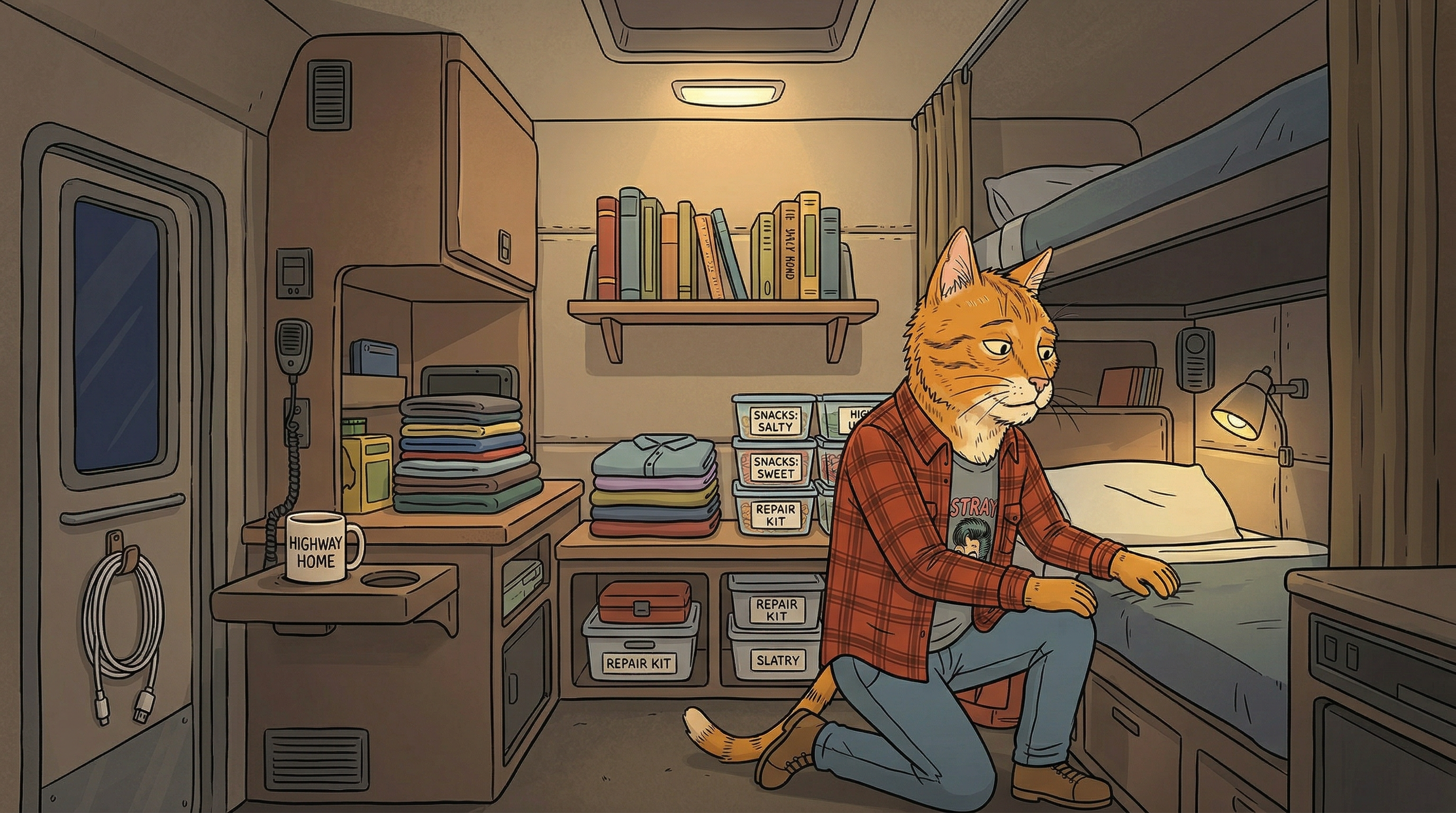
I was ten years old. Fourth grade. Redheaded. Weird. Getting beat up with a regularity that suggested scheduling.
I didn't know the word "autism." Nobody did — not for a kid like me, not in the early '80s. Autism was Rain Man. Autism was nonverbal. Autism was institutional. Autism was not a scrawny redheaded kid in fourth grade who talked too much about the wrong things and couldn't figure out why nobody wanted to sit with him at lunch.
I knew one thing: I was weird, and weird was getting me hurt.
So I decided to fix it.
I'd read a book. Will, by G. Gordon Liddy. I was a hyperlexic kid — taught myself to read at about three, which is its own story for another post — and by fourth grade I was consuming anything I could get my hands on. Will is the autobiography of a man who was terrified of everything and systematically conquered each fear through direct confrontation. Afraid of rats? He ate a rat. Afraid of lightning? He stood in a storm. Afraid of fire? He held his hand over a candle until the fear burned away.
A normal fourth grader reads that and thinks "that guy's crazy." I read it and thought: "Oh. You can just... do that? You can take the thing that's hurting you and walk toward it until it stops?"
The book gave me the method. The rest I engineered myself.
Here is what I built. I was ten.
I had a desk lamp in my room. The kind with the adjustable neck, the metal shade, the utilitarian design that existed in every American childhood bedroom in that decade. I put a 150-watt bulb in it. If you've never been close to a 150-watt incandescent bulb, they're not just bright — they're hot. You can feel them on your skin from a foot away. The light is aggressive. It doesn't illuminate a room; it attacks it.
I had a stereo. Old school, the kind with the cassette deck and the radio dial and the over-ear headphones that clamped your skull like a vice. I tuned it to a dead station. Static. Full volume. Not music, not talk — pure noise. The sound of nothing amplified to everything.
I had a wool sweater. The itchiest one I owned. No t-shirt underneath. No undershirt. Just the wool against bare skin, every fiber a needle, every movement a fresh irritation.
I would put on the sweater. I would put on the headphones. I would turn the static to full volume. And I would sit at my desk and stare directly into the 150-watt bulb from close range.
Light burning my eyes. Static filling my skull. Wool shredding my skin. Every sensory channel maxed. Every input screaming.
And I would sit there. And I would try to function.
What I was doing — what a ten-year-old with no vocabulary for it and no help and no diagnosis was doing — was building a desensitization machine. A feedback engine. I was flooding every sensory channel simultaneously and then teaching myself to operate inside the flood.
Here's what happened, after enough sessions:
I could take a step back from myself.
Not physically. Mentally. The light would be burning and the static would be screaming and the wool would be clawing, and then — somewhere inside the overload — a separation would occur. A small distance between me and the input. The light was still there, but it was less bright. Not because it dimmed. Because I moved. Internally. I found a place one step back from the raw signal, and from that place, I could manage.
I was ten years old and I taught myself to dissociate on purpose.
I want to be careful with that word. Dissociation has clinical weight. It's associated with trauma, with disorders, with things that require professional intervention. And I want to be honest: what I built was probably not healthy. A child shouldn't have to train himself to disconnect from his own senses in order to survive elementary school. A child shouldn't have to stare into a light bulb until his eyes water and his head throbs because the alternative is being the weird kid who flinches at fluorescent lights and can't wear the school uniform without scratching his arms raw.
But nobody knew. I didn't know. Autism wasn't a thing yet — not for kids like me. ADHD wasn't a thing yet — not the way I had it. There was no vocabulary. There was no framework. There was no therapist who would have looked at a ten-year-old building a sensory overload chamber in his bedroom and said, "Oh — he's autistic. The light sensitivity, the fabric sensitivity, the sound sensitivity — those are sensory processing differences. He doesn't need to desensitize. He needs accommodation."
Nobody said that. So I did what I thought I had to do.
I toughened myself up for the world that was forming in front of me.
It worked.
I need to say that clearly because the part of me that now understands what I did to myself wants to frame it as purely harmful, and that's not honest.
It worked. The feedback machine taught me something that has defined my entire life: I can endure discomfort to get the task done. I can sit inside an overwhelming situation and find that one-step-back place and function. I can wear the wrong clothes and stand under the wrong lights and exist in the wrong noise level and still show up. Still talk. Still work. Still move through the world like someone who isn't being assaulted by his own senses at every moment.
The feedback machine made me the person who doesn't quit.
It also made me the person who doesn't know when to stop. The person who pushes through pain signals that exist for a reason. The person who trained his own distress response out of himself at ten and has spent four decades not knowing when he's overwhelmed until he's already past the breaking point.
Gift and curse. Same mechanism. Same machine.
The mask came next.
Once I could manage the sensory input — once I could stand inside the flood and function — the next problem was the social input. The lights and the sounds and the textures were external. The social stuff was worse because it was interactive. You can desensitize yourself to a wool sweater. You can't desensitize yourself to the look on someone's face when you've said the wrong thing.
So I did the next logical thing: I started acting like everyone else.
Not a conscious decision, exactly. More like — I watched. The way an anthropologist watches. I studied what the other kids did, how they talked, what they laughed at, how they moved. And I replicated it. Not all at once. In pieces. This joke format works. This body language reads as friendly. This tone of voice means I'm listening.
I got good at it. Really good. Good enough to make friends. Good enough to seem normal. Good enough that nobody looked at me and thought "autistic."
And then the pattern would start.
New group. New friends. I'm the version of me that matches them — their humor, their energy, their interests mirrored back. It works. We get close. Weeks, months, sometimes longer. And then — as the closeness increases, as the guard comes down, as the energy required to maintain the performance exceeds my ability to sustain it — the mask slips. A little at first. Then more.
The real responses start leaking through. The flat affect. The too-direct comment. The sudden need to leave. The obsessive monologue about something nobody else cares about. The inability to perform interest in something I'm not interested in. The failure to respond correctly to an emotional moment because I'm processing it on a seven-second delay.
And the friends pull back. And the distance opens. And eventually I'm alone again. Not because I did something wrong. Not because I'm a bad person. Because my brain works differently, and that puts people on edge, and edge becomes distance, and distance becomes gone.
This pattern has repeated — conservatively — fifteen to twenty times across my life. Same arc every time. Approach, connect, reveal, retreat.
I'm not a bad person. I say that because I spent decades wondering if I was.
The discovery came late. After the brain injury.
Here's the thing about the brain injury that nobody tells you: it doesn't just damage what's broken. It damages what you built on top of what's broken. Forty years of compensatory architecture — the feedback machine, the masks, the social scripts, the dissociation techniques, the entire operating system I'd hand-coded from scratch — all of it ran on neural pathways that the injury disrupted.
The tools I used to mask and contextually move through the world? They broke. They stopped working. Overnight.
Imagine driving a truck with a manual transmission you've mastered for twenty years, and one day the clutch is gone. Not broken — gone. Your foot goes down and there's nothing there. You know how to drive. Your body remembers every motion. But the mechanism doesn't respond anymore.
That's what happened to my social operating system after the injury. The masks were still in memory, but I couldn't deploy them. The scripts were still written, but I couldn't read them fast enough. The one-step-back place that the feedback machine had taught me to find — I couldn't find it anymore. The lights were too bright again. The sounds were too loud again. The wool was back against bare skin.
I was ten years old again. Except I was fifty.
ADHD came first.
I watched a video — just a random thing in my feed, the algorithm doing its thing — about ADHD in adults. And I sat there with my mouth open. Because I thought ADHD meant hyperactive. I thought ADHD meant the kid bouncing off walls. I didn't know about the inattentive type. I didn't know that "my brain won't slow down, it just keeps making connections about everything around me, and it can be so fucking tiring" was a symptom and not a personality flaw.
That was the first crack. Oh. Maybe there's a name for this. Maybe I'm not just bad at being a person. Maybe there's a reason.
I watched more videos. I took the real assessments — not BuzzFeed quizzes, the actual clinical screening tools. Scored high on everything. "You should probably talk to someone about this." Yeah. I probably should.
Autism came after, and it came sideways.
The algorithm kept serving me autism content alongside the ADHD content, and I kept dismissing it. "That's just ADHD overlap." "That's common comorbidity stuff." "I'm not autistic, I just have ADHD." The denial was a wall, and the wall held for weeks.
Then I watched a video by an autistic woman. High-masking. Late-diagnosed. And she described — precisely, specifically, with the kind of detail that only comes from lived experience — what it feels like to mask so well that nobody believes you when you tell them you're struggling. What it feels like to mirror people so effectively that you lose track of who you actually are. What it feels like when the mask slips and the friendship ends and you're alone again wondering what's wrong with you.
It felt like getting kicked in the fucking chest.
I went down the rabbit hole. Autism in women. Female-presenting autism. And here's the thing that nobody expects: my autism presents more like the typical female profile. The high masking. The social mirroring. The ability to perform neurotypicality so convincingly that professionals miss it. The parts that are "supposed to be" more common in autistic women — the camouflaging, the chameleon effect, the ability to read a room and become what it needs — those are my parts.
The part that doesn't fit the female profile: I don't have the heightened empathic component. I care about people. Genuinely. But people have always been scary to me. I'm always on edge around them. The caring happens at a distance, through acts and objects and carefully constructed bridges — not through the easy emotional flow that a lot of autistic women describe.
So I'm a man with female-presenting autism and an ADHD brain and a forty-year-old DIY desensitization habit and a broken mask and a brain injury. My diagnostic profile doesn't fit in any box they've built.
When it clicked — when the autism piece fell into place — everything snapped into focus.
Every friendship that died the same death. The feedback machine. The wool sweater. The inability to make small talk without running a translation layer. The jobs that failed. The truck that saved me. The pattern recognition that won't turn off. The feeling of being on edge in every social situation, forever, no matter how safe the people are.
The years — decades — of wondering: am I a psychopath? Is something wrong with me? Why don't I feel things the way other people feel things? Why is everything so loud and so bright and so much, always, all the time?
Fifty-some years of living as a question, and then the answer arrives, and the answer is: your brain works differently. That's it. That's the whole thing. You're not broken. You're not a psychopath. You're not weird in some unnameable way. You're autistic. There's a word. There's a community. There's a literature. There's an explanation for all of it.
I cried. Not dramatically. Not in a movie way. I sat in a room and tears ran down my face and I didn't make a sound because that's how I cry — quietly, efficiently, the way I do everything — and I thought: fifty fucking years.
I don't have a formal diagnosis. I'm going to be straightforward about that.
I've taken the clinical screening tools. I've scored well above the thresholds. I've talked to neurologists and neuropsychiatrists — the people I see for the brain injury — and floated the question. They all said the same thing: "Yes, you very well might be autistic. It would not hurt to get assessed." But they couldn't do it themselves. The formal assessment requires specific professionals, specific protocols, specific time and money and emotional energy that I frankly don't have and don't want to spend.
Here's where I land: at this point in my life, I don't need a piece of paper. The knowledge is enough. Understanding why my brain does what it does has already changed how I live, how I work, how I relate to people, how I forgive myself for the things I couldn't do and celebrate myself for the things I could. A formal diagnosis would add a stamp. It wouldn't add understanding.
The process itself — the assessments, the appointments, the explaining and re-explaining to strangers, the masking during the evaluation that's supposed to detect masking — would honestly be harder on me than whatever validation the diagnosis provides. I know who I am. I know what I am. I've known since the wool sweater. I just didn't have the word.
If you're reading this and you're in the same place — self-identified, self-aware, clinically supported but not formally stamped — I see you. Your experience is real whether or not it's in a file somewhere. The fourth-grade kid with the feedback machine doesn't need a doctor to tell him what he already knows.
And if you're reading this and you think self-diagnosis isn't valid: I built a sensory desensitization chamber out of a desk lamp and a stereo when I was ten. Without help. Without language. Without anyone telling me what was wrong or how to fix it. I reverse-engineered my own neurology through trial and error and physical pain, and I used what I learned to survive for four decades in a world that wasn't built for my brain.
I think I know what I am.
The feedback machine is gone. I don't do it anymore. I don't need to — not because the sensory issues went away, but because I finally understand what they are, and understanding is a different kind of distance. Not the dissociative step-back I trained into myself at ten. Something gentler. Something that says "the light is too bright" instead of "I need to be tougher."
It took fifty years to get here.
The ten-year-old with the wool sweater would be relieved. I think. Or maybe confused. He didn't know he was building a life. He thought he was just surviving one.
Both, kid. It was always both.
Next time: The Eye Contact Equation — a precise mathematical model for how much eye contact is required in different social contexts, presented with the straight-faced earnestness of a man who has in fact calculated this.