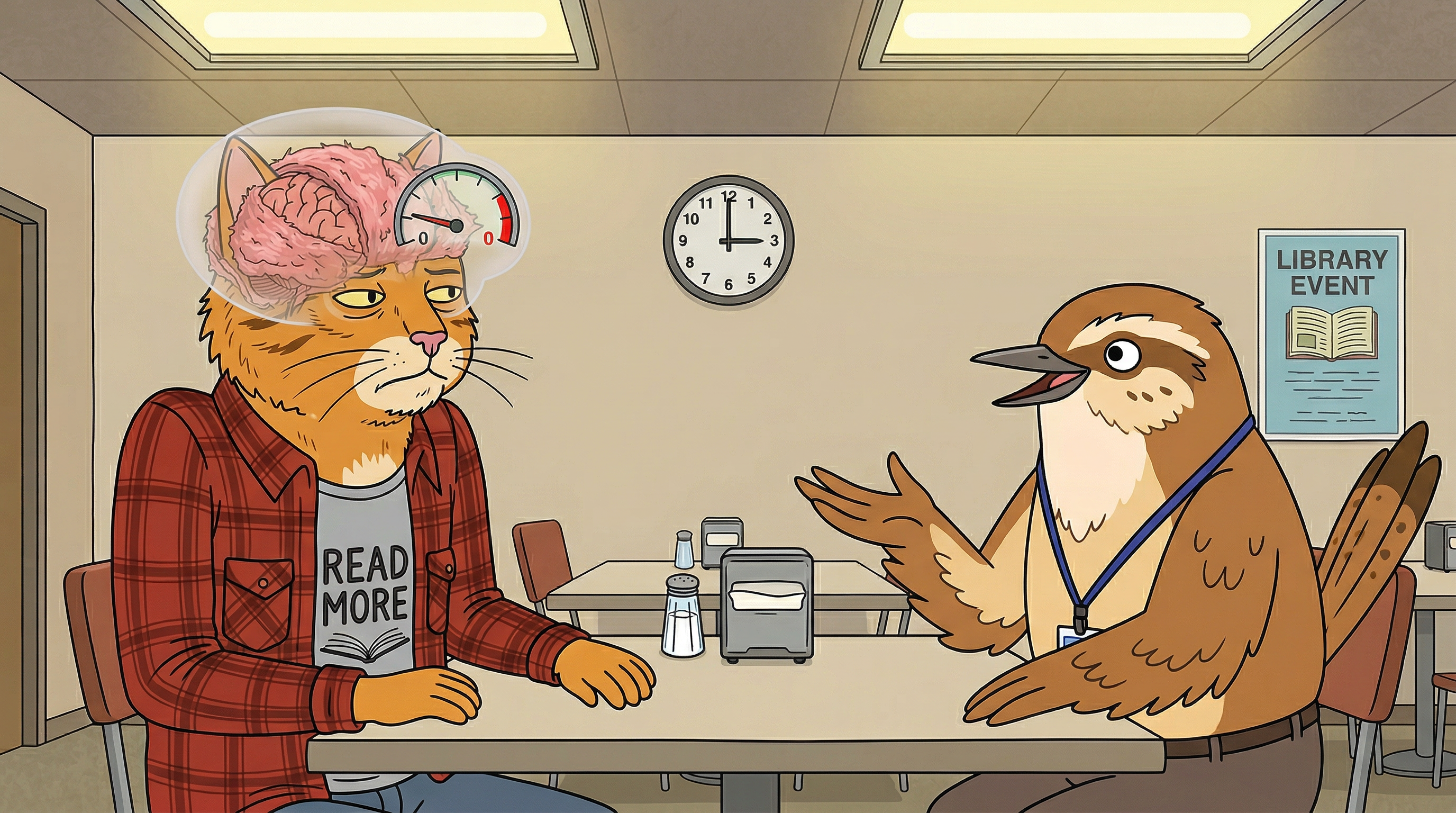
I need to describe something that I have never been able to describe, and I am going to try anyway, because I just figured out what it is after fifty years of experiencing it.
There is a sensation I get during certain conversations — not all conversations, not even most conversations — where my brain slows down. Not figuratively. Not "I'm bored" slow. Physically slow. Like the gears that turn my thoughts are suddenly being dragged through something thick and abrasive. Thinking becomes effortful in a way that is completely disproportionate to the complexity of what I'm being asked to think about.
Small talk does this. Not always. But often enough that I've built my entire social architecture around avoiding it.
Here's the thing: it's not just slow. It's a sensation. It has a texture. And until this week, I had no framework for understanding why a cognitive experience has a texture at all.

Fiberglass. That's the closest I can get.
If you've ever handled fiberglass insulation without gloves — that invisible, invasive, abrasive itch that you can't locate precisely but can't ignore — that's what it feels like. Inside my skull. When someone asks me about the weather for the third time or tells me a story I can feel has no destination.
It's not painful exactly. It's not a headache. It's a material. My brain is being rubbed with something it can't get away from, and my body responds to it the way a body responds to any physical irritant: I flinch. I withdraw. My chin goes up, my shoulders pinch together, my whole upper body seizes like someone just poured a cold bucket of water down my back. That's what my brain wants to do. That's the honest response.
But I'm an adult in a conversation, so I fight it. I try to maintain. I force myself to stay level while my body is screaming to flinch. And that's when the psychomotor retardation kicks in — all available processing power gets diverted to suppressing the flinch, and there's nothing left for the conversation. The gears stop. The molasses thickens. I go flat.
I have been doing this my entire life. I thought I was just rude.
THE MECHANISM:
I have audio-tactile synesthesia. I've known this for a while. Certain sounds don't just enter my ears — they arrive as textures on my skin, in my teeth, behind my eyes. A fork scraping a plate isn't a sound. It's a material event. It has grain and edge and temperature. My brain crosses the wires between hearing and touching, and the result is that sounds have a physical dimension that most people don't experience.
What I did not understand until this week is that the same cross-wiring applies to cognitive states.
My brain doesn't just convert sounds into textures. It converts experiences into textures. Boredom isn't an emotion for me. It's a fabric. Understimulation isn't a mood. It's a viscosity. And the specific texture of a conversation that doesn't generate enough neurological reward to sustain engagement is fiberglass.
Here's the chain:
The conversation starts. My ADHD brain measures the dopamine yield — not consciously, not deliberately, the way your thermostat measures temperature. The yield is insufficient. My prefrontal cortex, the part of my brain responsible for sustained attention and social performance, begins to throttle down. Processing speed drops. Not metaphorically. Actually. Measurably. The same way a computer reduces clock speed when it can't justify the power expenditure.
And then the synesthesia kicks in.
The throttle — which is a neurological event — gets translated into a sensory event. The cognitive slowdown becomes a physical texture. The fiberglass appears. And my body responds to the physical sensation because my body doesn't know it's not physical. My nervous system can't tell the difference between "a bad sound is touching my brain" and "a bad conversation is touching my brain." The signal arrives at the same place, through the same channel, as the same category of threat.
My chin goes up. My shoulders pinch. And then I catch it and force everything level — which burns every remaining resource I have. My face flattens because all available processing power is now being diverted to suppressing a flinch, not maintaining a conversation. And the person across from me sees a man who looks bored, or contemptuous, or checked out, or like an asshole.
THE SPIRAL:
Here's what makes it cruel: I can see it happening.
I can see the other person registering my withdrawal. I can feel them reading my flat affect as disinterest. I am watching someone feel rejected by me in real time, and I cannot stop the thing that is causing it, because the thing that is causing it is my nervous system responding to a sensation that I only just learned has a name.
So I try harder. I force engagement. I push through the fiberglass. And pushing through fiberglass costs dopamine I don't have, which deepens the deficit, which thickens the texture, which increases the flinch response, which makes my face flatter, which makes me look like more of an asshole.
The spiral tightens until one of us leaves.
I have lost friendships to this. I have lost professional relationships. I have lost opportunities I'll never know about because someone met me at a networking event and I turtled through four minutes of weather and sports and they walked away thinking I was the coldest person in the room.
I wasn't cold. I was being abraded.
THE HIERARCHY:
I've been mapping this, the way I map everything else. The textures have a hierarchy:
Stimulating conversation: Smooth. Warm. Frictionless. I could talk for eight hours and feel like it's been twenty minutes. The gears spin free. No texture at all — just flow. This is why people who know me well think I'm the most engaged person they've ever met. Because when the dopamine is there, the throttle opens all the way and I am entirely present in a way that neurotypical attention doesn't quite reach. Neutral interaction: Nothing. No texture. A cashier, a brief exchange, a passing hello. The engine doesn't engage deeply enough in either direction to produce a sensation. Understimulating interaction: Resistance. Drag. Like thinking through cold honey. Not painful yet. But effortful. I can sustain this for about fifteen minutes before the texture begins to shift. The fiberglass zone: Sustained understimulation without escape. A meeting that should have been an email. A party where I don't know anyone and everyone is discussing things I can't generate dopamine about. The texture appears. The turtle begins. The clock stops moving.THE FIFTY-YEAR DELAY:
I am forty-nine years old. I just understood this.
Not the sensation — I've felt the sensation since I was old enough to be in a room full of adults talking about nothing. I understood the sensation the way a person born in a house with a gas leak understands the headaches. It's just how things are. You don't question the air you breathe.
What I didn't understand was the mechanism. The synesthesia converting the dopamine deficit into a texture. The ADHD creating the deficit. The autism making the social environment the most likely trigger. Three conditions, each invisible, each identified late or not at all, conspiring to produce a sensation that I interpreted as a character flaw for half a century.
I thought I was rude. I thought I was broken. I thought the fact that certain people made my brain itch was evidence that I was a bad person who didn't value other human beings enough.
I am not a bad person. I am a person whose brain converts boredom into fiberglass and whose body tries to protect itself from the texture by doing the one thing that makes social situations worse: withdrawing.
THE TELL:
I have a tell. Beth knows it. A few close friends know it. When the fiberglass starts, my chin goes up. My shoulders pinch together. My whole body does the cold-water flinch — that involuntary seize you do when ice hits the back of your neck. That's the honest reaction, the one my body wants to complete.
But I catch it. I suppress it. I try to hold the conversation like a man holding a live wire and pretending it's a handshake. And that's when I go flat. That's when my face empties and my processing speed drops to nothing and I look like the coldest person in the room. It's not withdrawal. It's the cost of suppressing a flinch for the duration of a conversation.
If you know me and you see the shoulders pinch — even for a second before I catch it — you have about ninety seconds before I'm gone. Not angry. Not rude. Just gone. Behind the fiberglass, spending everything I have on not flinching, with nothing left for the conversation.
The kind thing to do is let me leave. The kinder thing is to change the subject to something with enough dopamine to clear the fiberglass. The kindest thing anyone has ever done is notice the pinch and say, without judgment, "let's go."
THE KIDS:
I need to say something about the kids.
You've seen them. The nonverbal autistic children in grocery stores, in malls, at family gatherings, wearing noise-canceling earmuffs. People look at them with pity or confusion or impatience. People think they're "sensitive." People think the earmuffs are an overreaction.
I think I know what those kids are experiencing. I think it's pain.
Not metaphorical pain. Not "discomfort." The same fiberglass I'm describing — a sensory event that their nervous system processes as a physical assault. The same abrasive, invasive, impossible-to-locate texture that I've spent fifty years learning to mask through. They can't mask. They don't have the years of practice. They don't have the social script that says "stand here and pretend your brain isn't being sanded."
The earmuffs aren't an overreaction. They're armor. Those kids are protecting themselves from a texture that the adults around them cannot feel and therefore cannot understand.
I was one of those kids. I just didn't get the earmuffs. I got fifty years of people thinking I was rude.
THE REFRAME:
Here's what I want you to understand, if your brain does this too:
You are not an asshole. You are not cold. You are not broken. You are a person experiencing a sensory event that the person across from you cannot perceive, in a dimension they may not have access to, triggered by a neurochemical deficit they've never had to think about.
Your withdrawal isn't rudeness. It's a flinch. Your flat affect isn't contempt. It's triage. Your escape isn't rejection. It's survival.
And the person who walks away thinking you're the coldest person in the room? They're not wrong about what they saw. They're wrong about what caused it. And you couldn't explain it to them because until right now, you didn't have the words.
Now you do.
MINIMUM RPM:
My brain has a minimum RPM. Below that threshold, it doesn't idle. It stalls. Small talk is below the minimum RPM. When the engine stalls, I can feel it. Not emotionally. Physically. Like gravity got heavier in just my skull.
Some engines need premium fuel. Some engines need to be moving fast to stay running. Mine needs the conversation to matter, or the gears grind, or the fiberglass comes, or I disappear inside my own neck like a man trying to hide from a sound that isn't a sound.
I spent fifty years thinking the engine was broken.
The engine is fine. It's a racing engine. It was never meant to idle.
< cab radio: static, then Tyler Childers, then nothing >
Next time: Pattern Log #005 — something I haven't mapped yet, but I will. I always do.
He's sitting in the break room at the library. His shift starts in ten minutes. A coworker just asked him about the weather. His shoulders pinched for half a second before he caught it. She didn't notice. She never does. He looks tired, but he's not tired. He's managing a texture that is already fading because she left and took the fiberglass with her. He rolls his shoulders back. Unclenches. He'll be fine in ninety seconds. He'll be fine. He's always fine. It just takes ninety seconds and a little silence and the gears start turning again, smooth and warm and free, the way they were always meant to.