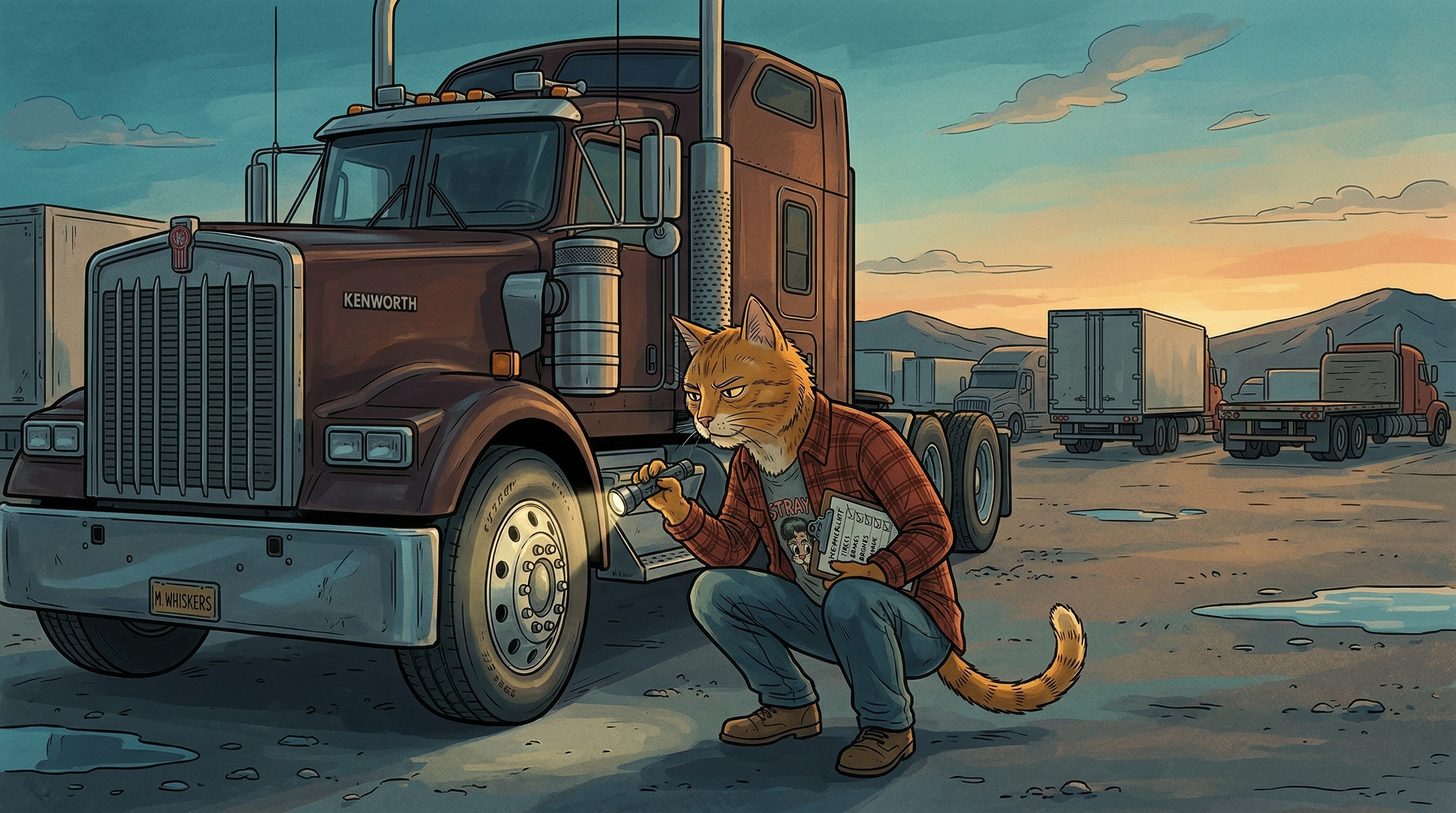
Picture this: you've been driving a truck for fifteen years. You know this truck. You know its blind spots, its turning radius, the way it pulls slightly left when the load is uneven. You've compensated for all of it. You're a good driver. Not because the truck is easy to drive — because you've memorized every single one of its quirks and built workarounds for all of them.
Then someone tells you the truck has been in the wrong gear the entire time.
Not broken. Not malfunctioning. Just — configured differently than you thought. And all those workarounds you built? They were brilliant. Genuinely impressive adaptations. But they were also completely unnecessary if someone had just told you about the gear.
That's what a late autism diagnosis feels like.
I was identified at an age that I'm going to keep vague because this isn't a medical history — it's a dispatch. What I'll tell you is that I'd been alive for multiple decades before a professional said the word "autism" in a sentence that also contained the word "you."
The first thing I felt was: nothing.
Not relief. Not grief. Not the dramatic movie moment where the protagonist stares into a mirror and sees himself for the first time. Just — nothing. Like being told the sky is blue. Yes. I know. I've been looking at it this whole time.
The second thing I felt, about forty-eight hours later, sitting in a truck stop parking lot in — I think it was Joplin, which is why I'm writing this from Joplin, because my memory is pinned to locations — the second thing I felt was:
Fury.Not at the identification. Not at the doctors who missed it. Not at my parents or teachers or anyone specific. Fury at the time. All the years I spent building workarounds for a truck I didn't know was in the wrong gear. All the energy. All the exhaustion. All the mornings I woke up tired not because I'd done something hard but because existing was hard and I didn't know it wasn't supposed to be that hard for everyone.
Decades of difficulty that had a name the whole time.
Here's what the late-identified autism experience is NOT:
It's not "finding out you have a superpower." That's the inspirational TikTok version, and it makes me want to drive into a bridge abutment (I won't, I'm fine, it's a figure of speech, please don't call anyone). Yes, there are advantages — the pattern recognition, the deep focus, the ability to exist comfortably in solitude. I've written about those. But framing the identification as a gift erases the thirty years of not knowing why you couldn't do the things everyone else did without thinking.
It's not "finally having an excuse." I've never needed an excuse. I needed an explanation. There's a difference the size of Texas between "I can't do this because I have a condition" and "I understand now why this has always been harder for me, and I can stop blaming myself for the difficulty."
It's not "joining a community." Maybe for some people. Not for me. The autistic community is full of wonderful people, and I am constitutionally incapable of joining communities. This is, in fact, one of the symptoms.
What it IS:
It's sitting in a parking lot in Joplin, Missouri, on a Tuesday, realizing that every single coping mechanism you've ever developed — the rigid routines, the noise-canceling headphones, the need to be alone after social events, the way you eat the same three meals in rotation, the fact that you chose the single most solitary profession available to someone without a degree — all of it was your brain solving a problem you didn't know you had.
And you solved it. That's the thing. You actually solved it.
You built a life that works for your brain without knowing what your brain was. That's not a failure. That's engineering. Blind engineering, in the dark, with no manual and no help, but engineering nonetheless.
The identification doesn't change the engineering. It just gives you the manual. Retroactively. Like getting the IKEA instructions after you've already assembled the bookshelf by trial and error and it's standing and it holds books and yeah, there are a few extra screws on the floor and one shelf is slightly crooked, but it works. It works.
The most useful thing about the identification, practically, is this:
Permission to stop compensating.Before the identification, every accommodation I made for myself felt like laziness. Leaving a party early = antisocial. Needing silence after work = moody. Eating the same lunch every day = boring. Choosing a job with zero social requirements = avoiding life.
After the identification, the same behaviors become: sensory management. Recovery from overstimulation. Routine as self-regulation. Playing to your neurological strengths.
The behaviors didn't change. The story about the behaviors changed. And the story matters because the story is what you tell yourself at 3 AM when you're wondering why you're like this.
The old story: "I'm like this because something is wrong with me." The new story: "I'm like this because this is how my brain works."
Same truck. Different gear. Smoother ride.
I'm going to be writing more about this. The specific experience of being an adult — a grown, working, bill-paying adult — who discovers that the operating system they've been running is not the one they thought it was. The recalibration. The grief (it comes in waves, months after you think you're fine with it). The strange relief of reading about autistic traits and going "wait, other people do that?" about something you thought was just you.
If you're reading this and you haven't been diagnosed but something is resonating: I'm not a doctor. I can't tell you what you are. But I can tell you that I drove for fifteen years in the wrong gear and still made it to every destination, and maybe you have too.
The manual helps. Even late.
Next time: The Dispatcher Problem — on the gap between what you mean and what people hear, and why "just say what you mean" is the most neurotypical advice ever given.