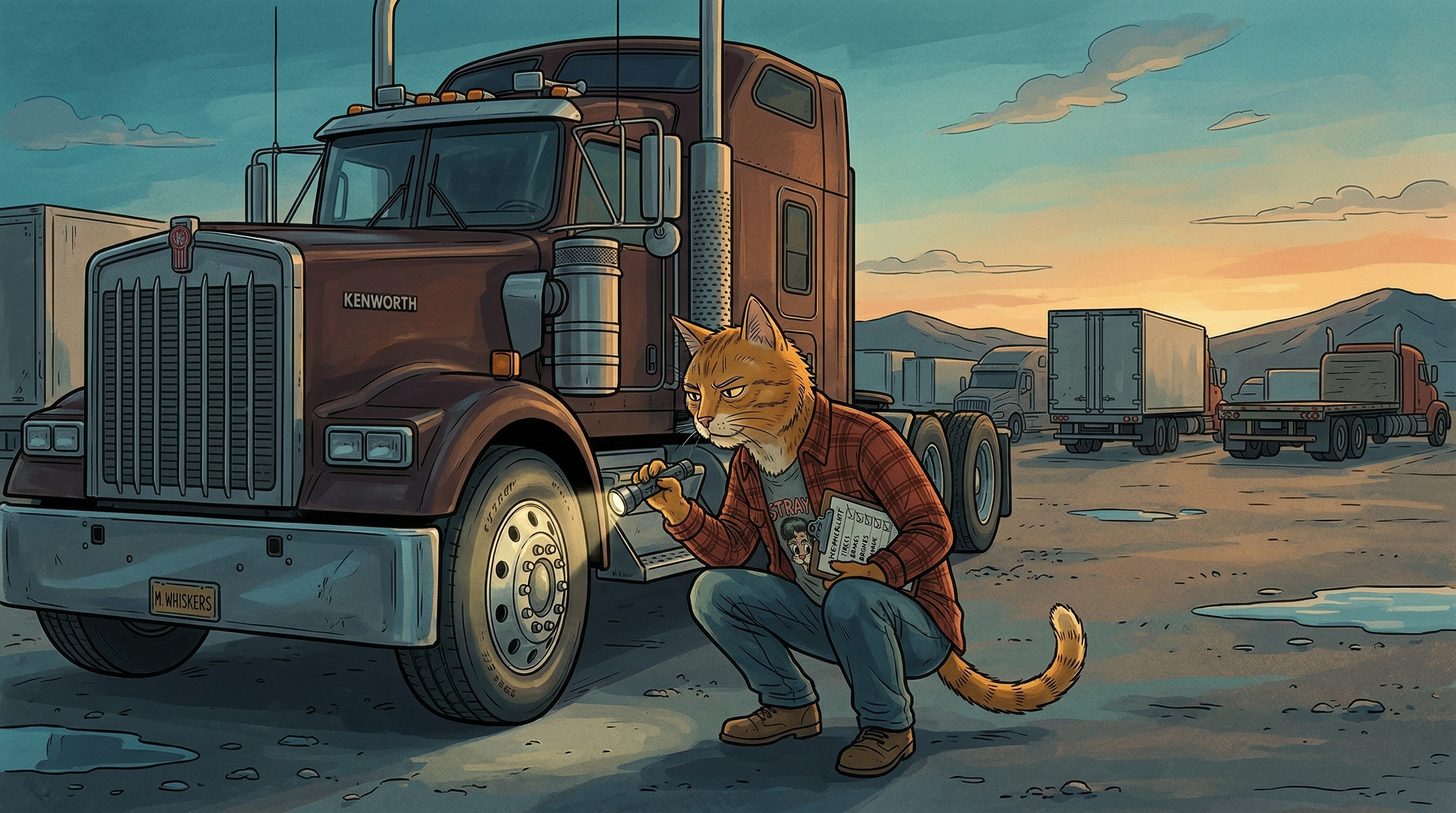
Picture this: you've been driving a truck for decades. You know this truck. You know its blind spots, its turning radius, the way it pulls slightly left when the load is uneven. You've compensated for all of it. You're a good driver. Not because the truck is easy to drive — because you've memorized every single one of its quirks and built workarounds for all of them.
Then someone tells you the truck has been in the wrong gear the entire time.
Not broken. Not malfunctioning. Just — configured differently than you thought. And all those workarounds you built? They were brilliant. Genuinely impressive adaptations. But they were also completely unnecessary if someone had just told you about the gear.
That's what learning you most likely have autism and ADHD at the age of fifty feels like.
I was forty-nine when a brain injury ended my trucking career. Not a fender bender. The kind of injury that rearranges things inside your head and doesn't put them back. I went on workers comp. Light duty. Landscaping, maintenance, whatever they could find for a broken trucker who couldn't drive anymore.
Here's the thing about the injury: it didn't just break my head. It broke the workarounds. Forty years of masking tools, coping mechanisms, compensation strategies that had gotten me through the Navy and a dozen careers after it. The injury turned the volume up on everything and stripped away the insulation I'd spent my whole life building. The truck was already in the wrong gear. Now the transmission was slipping too.
That's when the algorithm found me.
YouTube, doing what YouTube does. It had been watching me consume thousands of hours of physics and mycology and sacred geometry and engine repair and music theory, and it drew a conclusion I hadn't drawn myself. It started showing me autism content. I ignored it for months. It never stopped. Eventually I clicked.
And a stranger on the internet described my interior life like they'd been reading my source code.
The first thing I felt was relief.
Not a revelation. Not the dramatic movie moment. Just relief. Like finally finding the word for a sound you've been hearing your whole life. The sound doesn't change. But you stop thinking you're the only one who hears it.
And then the hard part: I couldn't tell anyone.
I was in the middle of a workers comp process for the brain injury. Introducing autism into that would have complicated everything. A whole separate neurological reality that nobody had flagged in forty-nine years, surfacing right in the middle of a legal process about a different neurological injury. So I sat with it. Alone. Mowing lawns and trimming hedges and knowing something enormous about myself that I couldn't say out loud.
I started quietly acting as if it were true. Giving myself the accommodations I'd always needed but never allowed. And my life got easier. Not fixed. Easier. The way driving gets easier when you finally find the right gear.
Here's what the late-identified autism experience is NOT:
It's not "finding out you have a superpower." That's the inspirational TikTok version, and it makes me want to drive into a bridge abutment (I won't, I'm fine, it's a figure of speech, please don't call anyone). Yes, there are advantages. But framing the identification as a gift erases the decades of not knowing why you couldn't do the things everyone else did without thinking.
It's not "finally having an excuse." I've never needed an excuse. I needed an explanation. There's a difference the size of Texas between "I can't do this because I have a condition" and "I understand now why this has always been harder for me, and I can stop blaming myself for the difficulty."
It's not "joining a community." Maybe for some people. Not for me. The autistic community is full of wonderful people, and I am constitutionally incapable of joining communities. This is, in fact, one of the symptoms.
What it IS:
It's sitting at your kitchen table on a Tuesday, realizing that every single coping mechanism you've ever developed — the rigid routines, the noise-canceling headphones, the need to be alone after social events, the way you eat the same three meals in rotation — all of it was your brain solving a problem you didn't know you had.
And you solved it. That's the thing. You actually solved it.
You built a life that works for your brain without knowing what your brain was. That's not a failure. That's engineering. Blind engineering, in the dark, with no manual and no help, but engineering nonetheless.
The identification doesn't change the engineering. It just gives you the manual. Retroactively. Like getting the IKEA instructions after you've already assembled the bookshelf by trial and error and it's standing and it holds books and yeah, there are a few extra screws on the floor and one shelf is slightly crooked, but it works. It works.
The most useful thing about the identification, practically, is this:
Permission to stop compensating.Before: every accommodation I made for myself felt like laziness. Leaving a party early = antisocial. Needing silence after work = moody. Eating the same lunch every day = boring.
After: the same behaviors become sensory management. Recovery from overstimulation. Routine as self-regulation. Playing to your neurological strengths.
The behaviors didn't change. The story about the behaviors changed. And the story matters because the story is what you tell yourself at 3 AM when you're wondering why you're like this.
The old story: "I'm like this because something is wrong with me." The new story: "I'm like this because this is how my brain works."
Same truck. Different gear. Smoother ride.
If you're reading this and something is resonating: I'm not a doctor. I can't tell you what you are. But I can tell you that I drove for decades in the wrong gear and still made it to every destination, and maybe you have too.
The manual helps. Even late.
Next time: The Dispatcher Problem — on the gap between what you mean and what people hear, and why "just say what you mean" is the most neurotypical advice ever given.