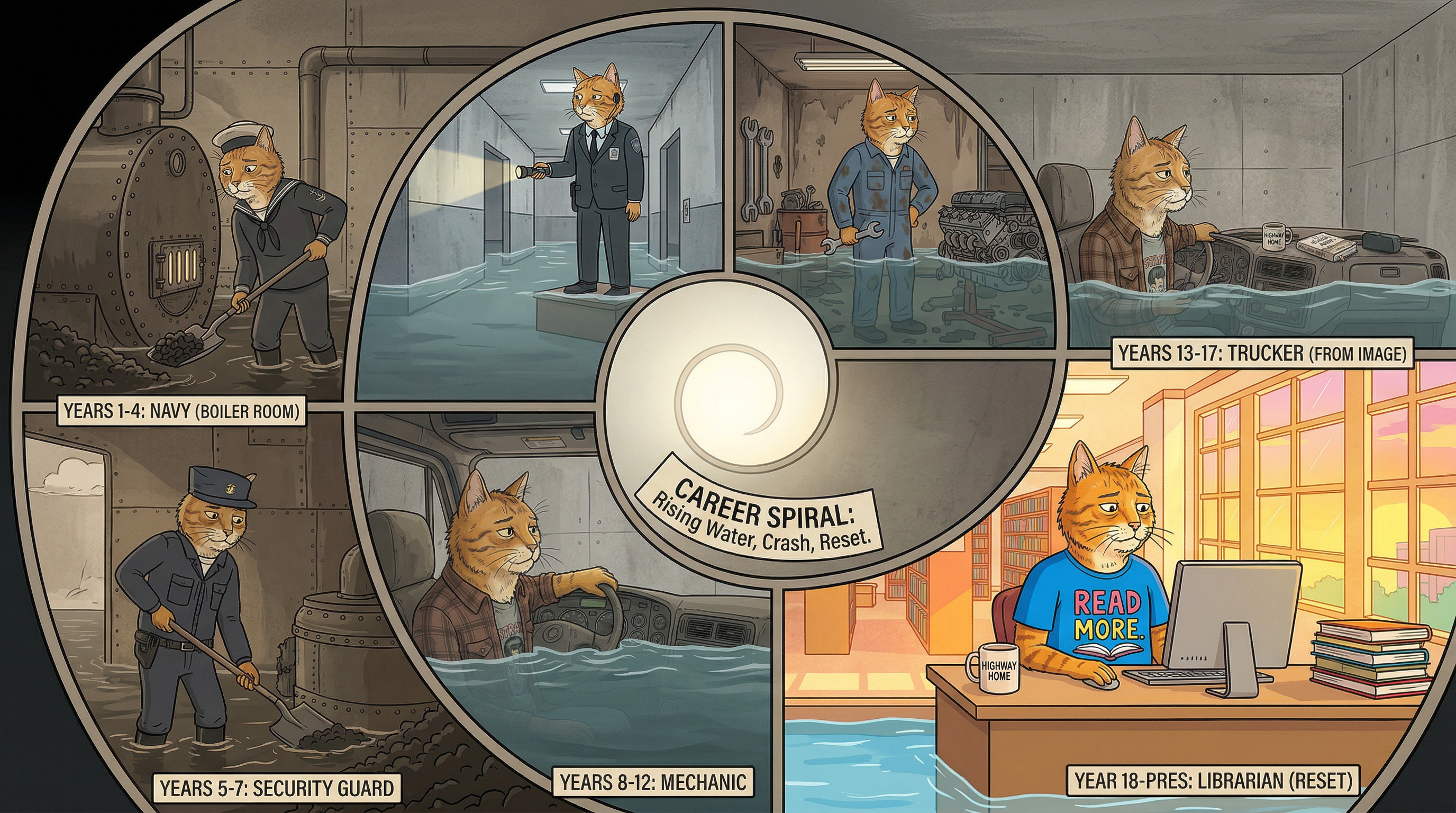
Navy propulsion engineer. Facilities maintenance tech. Diplomatic security specialist. Private security contractor. Hospital security officer. Diesel mechanic. Heavy equipment operator. Academic library assistant. Truck driver. Fleet supervisor. Truck driver again. Library assistant.
Also: bouncer. Dishwasher. Bartender. The jobs between the jobs. The ones that don't make the resume but keep the lights on during the reboots.
Also: five colleges. Northern Virginia Community College. Colorado School of Trades for gunsmithing. Wytheville Community College. New River Community College. Radford University. Graduated from none of them. The only diplomas I have are a high school degree and a certificate from bartending school. Bartending school was the most useful education I ever received, because it was the first one that taught the way my brain actually learns: watch, do, repeat, serve. No lectures. No abstracts. No performing comprehension for a professor who needs you to raise your hand to prove you're paying attention.
Read that list again. Find the thread. There isn't one — not one that makes sense on a resume, not one that a career counselor could map, not one that any reasonable person would look at and say "ah yes, a logical progression."
That's because the thread isn't professional. It's neurological.
Every career change was a system reboot. Not a pivot. Not a reinvention. Not "following my passion" or "seeking new challenges" or whatever language people use to make serial career changes sound intentional. Each one was the same event: the system crashed, and I had to rebuild from scratch in a different environment because the old one had consumed every resource I had.
That's autistic burnout. That's what it actually looks like from the inside. Not a bad quarter. Not a rough patch. A full system failure that requires reformatting the drive and reinstalling everything in a new location and hoping this time the operating environment doesn't eat through the budget before you can build a life.
It's never sudden. That's the cruelest part. It builds so slowly that you can't distinguish the decline from the baseline. It's like water rising in a room with no windows — you don't notice it's at your ankles until it's at your chest.
Month one of a new career: everything is novel. Novel is stimulating. Stimulating generates dopamine. The mask runs efficiently because there's enough fuel. You're the new guy. New guys get grace. Nobody expects you to be perfect. The social load is low because your role is simple: learn, listen, perform competence. You can do that. You're great at that.
Month six: the novelty fades. The dopamine from newness dries up. But you've built routines, and routines are efficient, so the system compensates. You're good at the job now. People like you. The subroutines are expensive but they're running clean. This is the plateau. This is where you think maybe this time it's going to work.
Year two: the compound interest of masking starts to show. Not in your work — your work is fine. In everything else. You're tired in a way that weekends don't fix. You stop doing things you used to enjoy because the energy isn't there. Your tolerance for sensory input shrinks. Small talk that used to cost two subroutines now costs five because the reserves are depleted and every process is running on fumes. You start canceling plans. You start driving the long way home because you need ten more minutes of silence before you walk into another environment that requires performance.
Year three or four or five — however long the specific system can sustain: the crash. It doesn't look dramatic from the outside. You don't throw a desk or scream at a boss or walk out mid-shift. You just wake up one morning and the system won't boot. The thought of performing the mask for one more day in that environment — not a bad environment, not a toxic environment, just THAT environment with THOSE specific demands on THOSE specific subroutines — produces a physical response that is indistinguishable from illness.
Because it is illness. Burnout is the system telling you it's been running at a deficit for years and the debt has come due and there is nothing left to borrow against.
THE CAREERS:
Navy. Four years in the boiler room of an aircraft carrier. 1,200 PSI superheated steam. 120 to 140 degrees in the fire room. I wouldn't call the Navy autistic-friendly. But I knew where I stood and what was required of me. Everything has a procedure. Everything has a manual. The hierarchy is explicit. The expectations are written down. You know exactly where you stand because they literally tell you where to stand. And nobody gave a shit if you were weird, as long as you did the job. That was the deal. Be weird, do the job, nobody bothers you. I thrived. Then the enlistment ended and nobody told me the civilian world doesn't come with a manual.
Facilities maintenance. First civilian job. HVAC, plumbing, electrical at a 265,000 square foot corporate facility. Machines again. Predictable problems with documented solutions. The work was fine. The corporate environment was the first time I realized that civilian workplaces run on unwritten rules and I didn't have the decoder ring. Nine months. Next.
Diplomatic security. High stakes. High social performance. Constant vigilance. Reading rooms, reading faces, reading threats. Every skill an autistic brain is actually spectacular at — pattern recognition, hypervigilance, systematic threat assessment — wrapped in a job that ALSO requires constant social masking at the highest possible level. Protecting people who expected a certain kind of presence. A certain kind of invisible competence that also projected visible confidence. The work was natural. The performance was lethal. The system couldn't sustain both. But it was the closest I'd felt to the Navy — clear mission, high stakes, explicit chain of command. And we were all weird. Every last one of us. Diplo sec attracts a certain kind of person and that person is not normal. Nobody cared about your quirks because everybody had them. So I went independent. Private contractor. Same work, fewer people to mask for. That bought me a couple more years.
Hospital security. The step down. Still security, but the intensity dropped and the tedium rose. Three years of patrols and access control and behavioral health incidents and de-escalation and the fluorescent hum of a hospital that never closes. The work wasn't hard. The environment was. Hospitals are sensory hell — the lights, the sounds, the smells, the constant low-grade emergency of a building full of people in crisis. I didn't burn out on the job. I burned out on the building.
Diesel mechanic. The logical reboot. Machines don't require eye contact. Engines don't need you to modulate your tone. Reconditioning Caterpillar diesel engines — teardown, cleaning, inspection, assembly, dyno testing. The sensory environment is brutal — noise, chemicals, vibration, temperature — but it's PREDICTABLE brutal. An autistic brain can handle a lot of sensory punishment if it's consistent. What it can't handle is the shop talk. The crew dynamics. The small talk between repairs. The social architecture of a mechanical team that functions on banter and ball-busting and a thousand unwritten rules about who you eat lunch with and what you say about the foreman. The machines were fine. The people around the machines were the same cost they always are.
Heavy equipment. Articulated dump trucks, wheel loaders, excavators, bulldozers. Outside. Alone in a cab. Big machine, simple task, move dirt from here to there. A year of that. The simplicity was a relief. The career ceiling was a wall.
Academic library assistant. Hollins University. Nearly six years — the longest I'd lasted anywhere since the Navy. Interlibrary loan coordination, reference, circulation, software implementation. Information systems. Pattern matching. Connecting people to what they need through a structured, searchable system. This was the first time the JOB itself matched how my brain works. The environment was small, academic, quiet. The social demands were real but bounded. I thought I'd found it. Almost six years. Then the water rose past my chest and I couldn't breathe in that building anymore and I left for the trucks.
Truck driver. The ultimate reboot. Alone. In a cab. With an engine and a road and nobody asking you to perform anything for anyone. The closest thing to a sustainable environment my brain had found. And it worked — for years. I was good at it. Good enough to get promoted to fleet supervisor, running a dedicated account solo — dispatching, load planning, payroll, DOT compliance, ten trucks, two hundred trailers. Every operational skill the Navy taught me, applied to logistics. Then the body started paying the price the brain wasn't. The loneliness. The physical toll. The accumulation of hours in a seat that doesn't care about your spine. A decade on the road. You can run from the social cost but you can't run from the biological one. The road didn't burn out my mask. It burned out my chassis.
And between all of these — in the gaps, during the reboots, when the last career had crashed and the next one hadn't started — I bounced. Bartender. Bouncer. Dishwasher. The survival jobs. The ones that keep the lights on while you figure out what configuration of human labor your brain can sustain next. Bartending was the best of them. The bar is a physical barrier between you and the other person. You have a station. You have tasks. The conversation has a built-in structure — they order, you make, they drink, you move on. Nobody expects deep eye contact from a bartender. Nobody thinks you're rude for walking away because there's another customer. The masking cost is lower because the architecture of the job provides the structure for free. Bouncing was even simpler. Stand here. Watch. Decide yes or no. Maximum pattern recognition, minimum performance.
The colleges happened in the gaps too. Five schools. Gunsmithing because I was good with machines. Criminal justice because I was good at security. General studies because I didn't know what else to try. None of them stuck. Not because I wasn't smart enough — because the learning environment wasn't built for how I learn. Sit in a room. Listen to a lecture. Raise your hand to perform comprehension. Write an essay proving you absorbed the material in the format the professor prefers. Every part of that costs subroutines. Every class was a four-hour masking event with homework. The content was fine. The theater of education was the tax I couldn't pay.
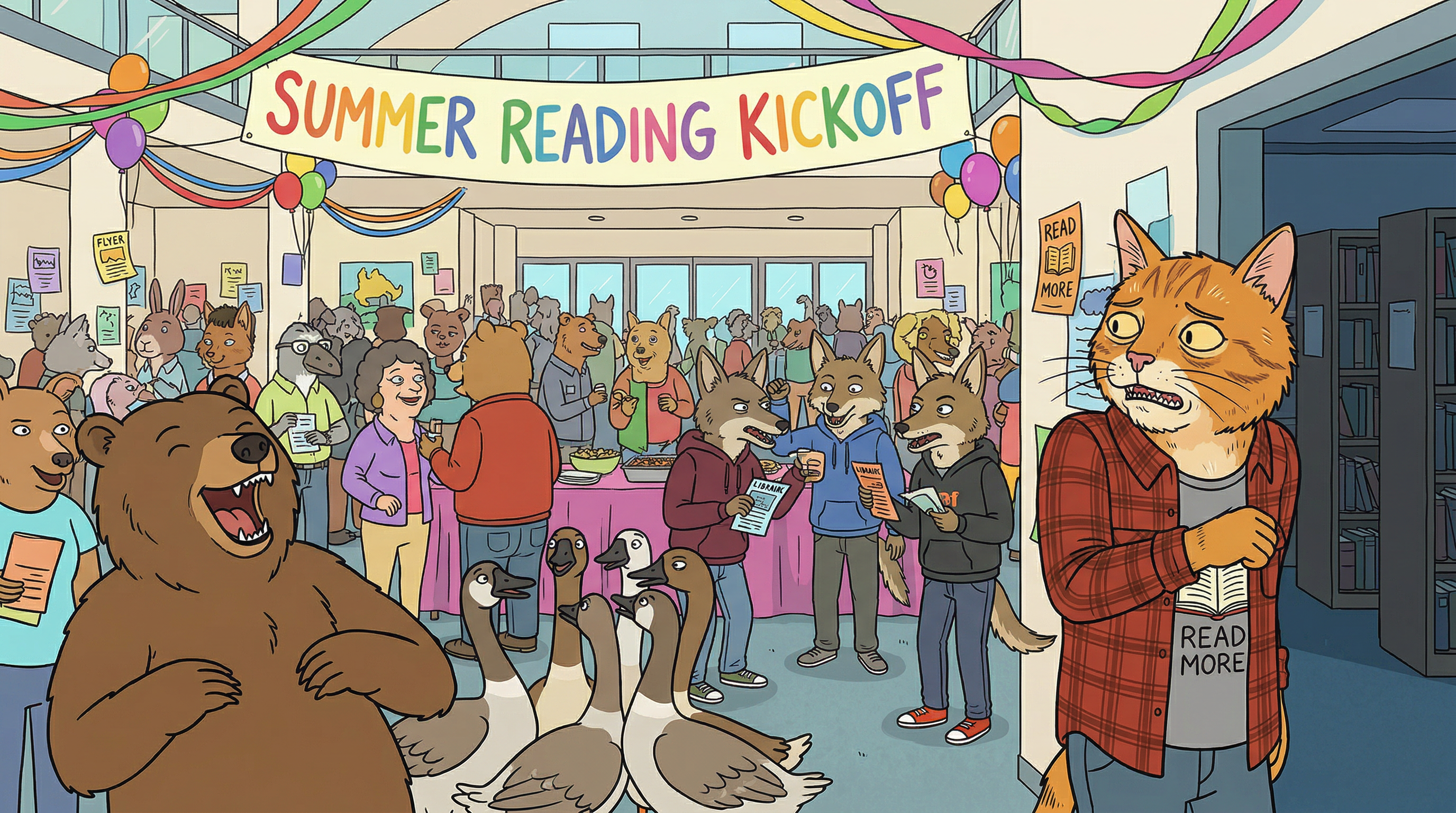
Libraries. The current iteration. The quietest public-facing job that exists. The social demands are real but structured — patron interactions have scripts, reference questions have protocols, the rhythm is predictable. The sensory environment is, by design, the lowest-stimulation public space in any community. Books don't make noise. The Dewey Decimal System is a pattern-matching paradise. It's the closest to sustainable I've found. Fifteen dollars an hour to exist in an environment that doesn't actively try to kill me.
And I can feel it building again. Not today. Not this month. But it's there, at the edges, the way it always is. The water is at my ankles and there are no windows.
WHAT NOBODY TELLS YOU:
Each reboot costs more than the last.
You don't start fresh. You start depleted. The savings from the last career are gone — spent on the transition, the retraining, the months of unemployment, the rebuilding of an identity from scratch. The social network from the last life is gone — they were work friends, and work friends don't survive the reboot. The confidence is gone — because you can't explain to yourself or anyone else why you keep "failing" at careers you were objectively good at.
You weren't failing. You were running a system that costs more than the salary pays. Not in dollars. In neurological resources. In masking capacity. In the finite, non-renewable energy that an autistic brain expends to exist in a neurotypical environment eight hours a day, five days a week, fifty weeks a year.
The math never works. The budget never balances. The deficit grows. The crash comes. The reboot starts. And each time, the recovery takes longer and the reserves are thinner and the hope that this time will be different is a little more worn.
THE THING ABOUT THE CURRENT REBOOT:
This time is different. Not because the library is sustainable forever — I can feel the math, and the math is the math. But because this time I understand what the math IS.
I spent thirty years rebooting without understanding why. Blaming myself. Blaming the job. Blaming some fundamental weakness that made me incapable of doing what everyone else seemed to do without thinking — which is work the same job for thirty years and retire with a watch and a pension.
They can do that because it doesn't cost them what it costs me. That's not a metaphor. That's neurology. Their mask runs in the background at 2% CPU. Mine runs in the foreground at 60%. Of course their system lasts longer. Of course their budget balances. They're running the same job on a fraction of the overhead.
Now I know. And knowing doesn't fix the math, but it changes the strategy. Instead of trying to find an environment that doesn't cost anything — that environment doesn't exist — I'm building one. An environment where the mask isn't required. Where the pattern recognition is the product, not the disability. Where the obsessive systematic thinking is the business model, not the thing I have to hide behind a modulated voice and managed eye contact.
I'm building a ship. The ship doesn't care if I make eye contact. The ship doesn't need me to modulate my tone. The ship needs me to see patterns and build systems and connect things that nobody else thinks are connected and work twenty hours straight when the hyperfocus locks in because the work is stimulating enough to sustain itself.
The ship is the first environment that might not require a reboot. Because the ship was built by the brain that keeps crashing, for the brain that keeps crashing.
We'll see. The water is always rising somewhere. But for the first time, I built the room with windows.
< cab radio: static, then Oliver Anthony, then nothing for two hundred miles >
Next time: the thing about libraries nobody tells you. Or maybe the thing about trucks. Or maybe the thing about all of it. There's a lot of things.
He closes the break room door and walks back to the desk. The patron queue is three deep. He boots the subroutines — smile, eye contact, voice modulation, conversational rhythm, spatial awareness, name recall. Six processes. Twenty percent of capacity. For a four-hour shift. The math doesn't work. The math never works. But the math is the math and the shift is the shift and the system boots because it always boots. Until it doesn't.