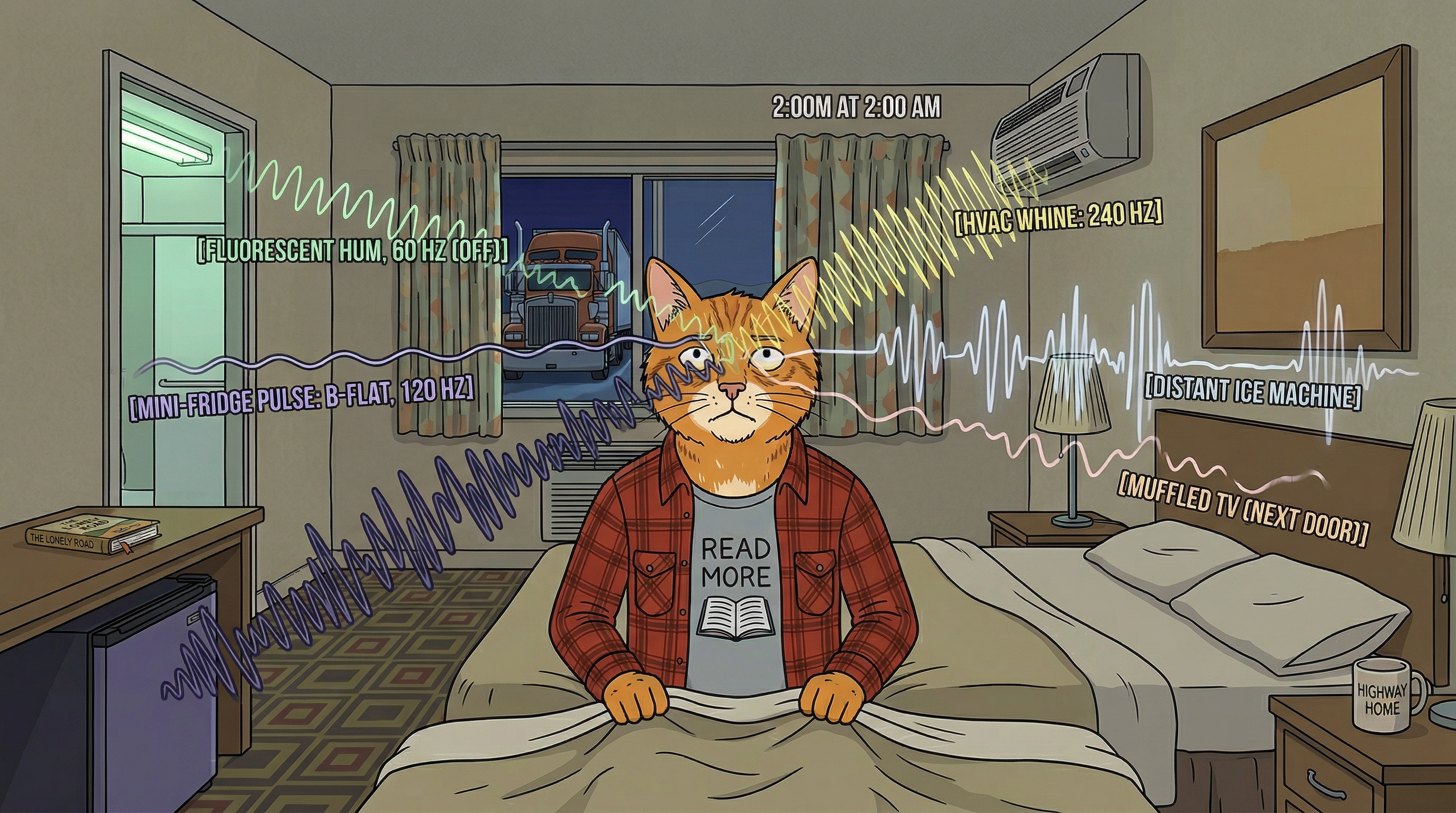
The refrigerator in this room hums at approximately 120 Hz. B-flat, two octaves below middle C. I know this because I can hear it. I've always been able to hear it. I thought everyone could hear it.
They can't.
This was one of the smaller revelations of the identification, but it rearranged more than you'd think. Because if other people can't hear the refrigerator — if their brains are genuinely filtering that frequency before it reaches conscious awareness — then I've been living in a louder world than everyone around me for my entire life. Not metaphorically. Literally. Measurably. The ambient sound floor in any room I enter is higher than the ambient sound floor other people experience in the same room.
I am always hearing more than you are. And I cannot turn it down.
The refrigerator is the easy example. Here's the full inventory of a Super 8 room in Indiana at 1:47 AM:
The refrigerator. 120 Hz. Constant. A low drone that sits under everything like a foundation you can't stop feeling through the floor.
The HVAC unit. Cycling. When it kicks on: a motor whine at roughly 240 Hz, plus a rattle in the housing that adds a non-harmonic overtone somewhere around 400 Hz. The rattle means a screw is loose or a panel is warped. I know this. I don't want to know this. My brain cataloged it anyway.
The fluorescent light in the bathroom. I turned it off an hour ago but I can still hear the ballast. 60 Hz. The most ubiquitous sound in American infrastructure. Every fluorescent light in every building on the North American power grid hums at 60 Hz because that's the frequency of the alternating current, and the ballast vibrates at that frequency, and nobody hears it except the people who hear everything.
The ice machine down the hall. Compressor cycle: 90 seconds on, 140 seconds off. I've been counting. Not on purpose. My brain counts things the way other people's brains breathe. It just happens.
The hallway. Footsteps, intermittent. A door closing — room 214, I think, based on the distance and the specific rattle of the security latch. Someone's TV playing through the wall — too muffled for content, but the rhythm suggests a talk show. Laugh track cadence: every 18-22 seconds.
This is what a quiet room sounds like to me.
Before the identification, I had a different explanation for all of this. I called it "being a light sleeper." I called it "being particular." I called it "I just need it quiet." These were translations — ways of expressing the experience in language that neurotypical people could accept without follow-up questions. Nobody questions "I'm a light sleeper." Everybody has a friend who's a light sleeper. It's normal.
What's not normal is lying in a motel bed at 1:47 AM mentally diagramming the acoustic properties of the room like a sound engineer doing a site survey.
After the identification, I understood the mechanism. Sensory processing. Specifically: sensory gating. Most brains have a gate — a filter that intercepts low-priority sensory input and discards it before it reaches consciousness. The refrigerator hum is low-priority. The fluorescent ballast is low-priority. The ice machine compressor cycle is low-priority. A neurotypical brain files these under "ambient" and moves on.
My brain doesn't have that gate. Or the gate is broken. Or the gate is open and I lost the key. The metaphor doesn't matter. What matters is: everything comes through. Every frequency. Every hum. Every rattle and click and compressor cycle. All of it, all the time, at full resolution.
The feedback machine.
I've written about the feedback machine — the thing I built at ten, the desk lamp and the static and the wool sweater. The sensory overload chamber I used to train myself to function inside overwhelming input.
I understand it differently now. What I was doing wasn't desensitization. Not exactly. I was building a manual filter. A hand-built, brute-force version of the gate that other people's brains run automatically. Sit inside the overload long enough and you learn to push certain inputs one step back — not gone, never gone, but managed. Demoted from foreground to something you can almost pretend is background.
I was ten years old, building by hand what other people's neurology does for free.
The manual filter worked. For decades, it worked. I could walk into a room full of fluorescent lights and refrigerator hums and HVAC rattles and push it all one step back and function. The cost was energy — masking points, though I didn't have that language yet. Every room I entered cost something just to be in, before any social interaction even started. The sound floor was a tax. A cover charge. A toll you pay before the road even begins.
The brain injury broke the manual filter the same way it broke everything else I'd built. The sounds came back to full volume. The refrigerator was loud again. The lights were loud again. Everything was loud again, and I was fifty years old and I didn't have the energy to rebuild what took a decade to construct.
The truck.
The truck is the only room where I control every sound.
Engine at 1400 RPM: I know the frequency. I know the harmonics. I know what changes when the turbo spools and what changes when the engine brakes engage. Every sound the truck makes, I've cataloged. Not because I wanted to. Because my brain did it automatically and eventually I stopped fighting the catalog and started using it.
Tires at 62 MPH on fresh asphalt: a specific broadband noise, centered around 800 Hz, that functions as white noise. Tires on concrete: higher pitched, more textured, 1200 Hz center. Tires on grooved pavement: rhythmic, pulsing, a frequency that depends on the groove spacing and the speed.
Lane markers: 136 BPM. I've done the math.
My playlist: chosen. Controlled. Every track selected for tempo and frequency content. Nothing surprising. Nothing I haven't heard before. The playlist is a known acoustic quantity in a known acoustic environment.
The truck is the only room that doesn't hum wrong.
Every frequency accounted for. Every sound source identified. Nothing coming through the gate that I didn't invite. The cab is a controlled acoustic environment, and in a controlled acoustic environment, the broken filter doesn't matter. There's nothing to filter. Everything present is supposed to be present.
This is why I sleep better in the truck than in any motel room in America. It's not comfort — the sleeper berth is a foam mattress in a metal box. It's acoustic sovereignty. The only room where the sound floor is mine.
It's 2:14 AM. The refrigerator is still humming. The HVAC just kicked off — the silence it leaves behind isn't silence. It's the fluorescent ballast and the ice machine and the TV through the wall and my own breathing, which is the one sound I've never minded, because it's the one sound that's always been there, in every room, in every state, and my brain filed it as "self" a long time ago and doesn't flag it anymore.
I'll sleep eventually. Or I'll drive. The truck is in the parking lot. The truck doesn't hum at 120 Hz. The truck hums at whatever I tell it to.
Next time: User Manual #003 — on the friend expiration date, and the five-phase pattern of every friendship I've ever had.