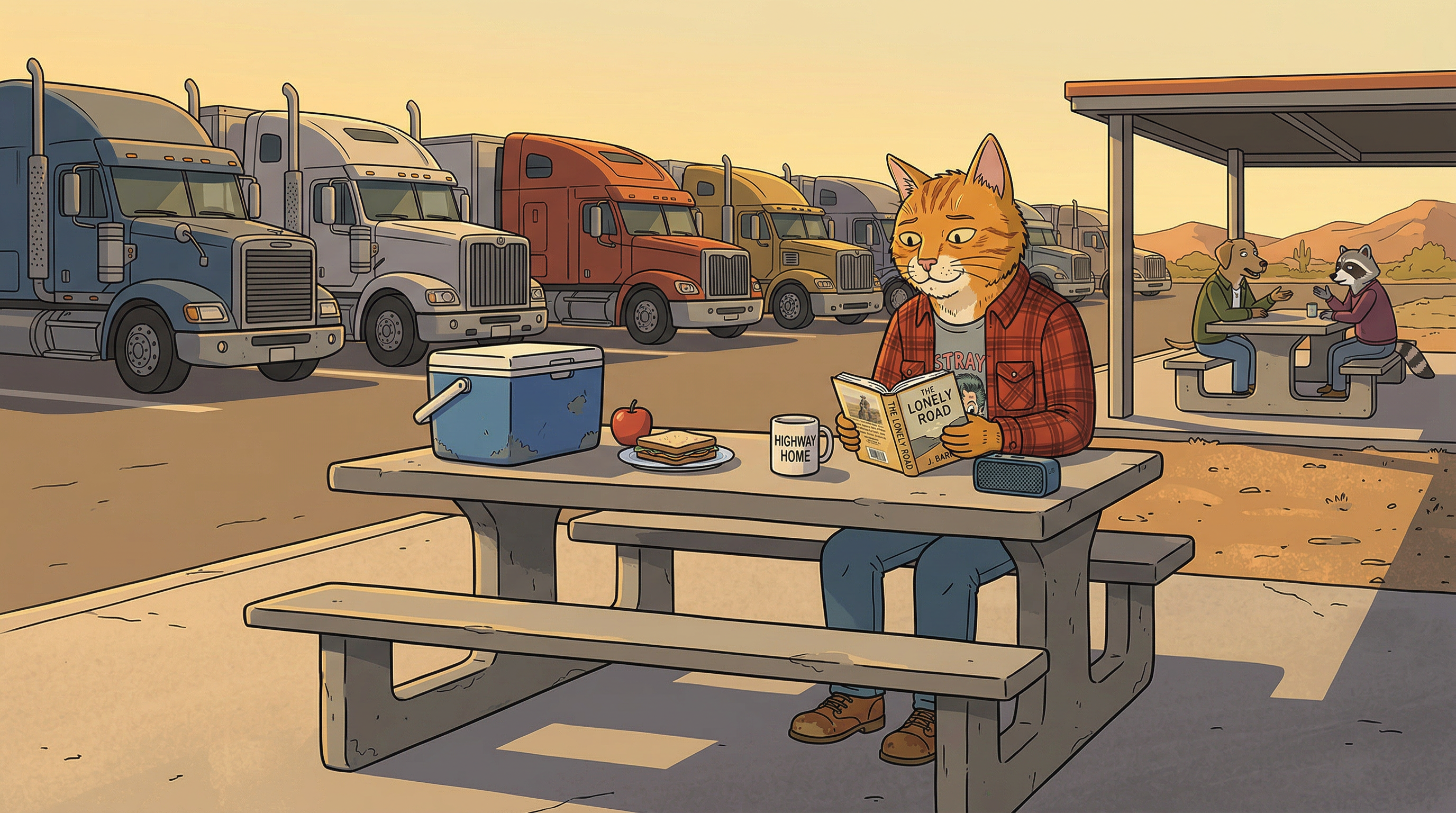
There's a thing that happens on long drives where you realize you need to stop. Not because you're tired. Not because you're hungry. Not because the gas gauge says so. You just — need to pull over. Sit in a parking lot. Be still. Let the engine tick and cool and not need anything from you for twenty minutes.
I used to think this made me broken.
I'd watch other people at rest stops — truckers (the social ones), families pouring out of minivans, couples arguing about the GPS — and they all seemed to be refueling in the traditional sense. Bathroom, coffee, stretch, go. Purpose-driven stops. Efficient.
I was never efficient about it. I'd sit in the cab with the windows down and just... decompress. Not from anything specific. From everything. From the radio and the road noise and the eighteen-wheeler that had been riding my lane for the last forty miles and the cumulative weight of being perceived by every car that passed me.
This was before I knew the word for it.
The word, it turns out, is overstimulation. Or if you want the clinical version: sensory processing differences consistent with Autism Spectrum Disorder, identified at fifty years old, approximately four decades after it would have been useful to know.
Here's what nobody tells you about a late autism identification: you don't learn something new about yourself. You learn a new word for something you've always known. The rest stop thing? I'd been doing that my whole life. I just thought everyone needed to sit in parking lots and stare at nothing sometimes. I thought the alternative — just going continuously, without needing to power down — was a skill I hadn't learned.
It isn't a skill. It's a different operating system.
The Rest Stop Theory of Social Energy goes like this:
You have a tank. Everyone has a tank. But the tanks are different sizes, they burn fuel at different rates, and — here's the critical part — they refuel differently.
Neurotypical refueling (as far as I can observe from the outside): social interaction tops off the tank. A party is a gas station. A good conversation is a fill-up. Being around people = energy in. My refueling: social interaction drains the tank. Every interaction, even the good ones, costs fuel. A party is a hundred-mile detour through the mountains. A work meeting is stop-and-go traffic. Even being around people I love — and I mean love, genuinely, deeply — draws the needle down. Not because I don't want to be there. Because my brain is processing every micro-expression, every tonal shift, every ambient sound, every possible subtext in every sentence, and it is doing this all the time, whether I ask it to or not.My brain doesn't have an idle mode. It's always in drive. The only question is how fast.
So I pull over.
The mistake I made for thirty-some years was treating rest stops as failures. Evidence that I couldn't keep up. That I was antisocial, or depressed, or not trying hard enough.
What I know now: rest stops are the system working correctly.
A computer that never sleeps doesn't crash because it's weak. It crashes because sleep is part of the architecture. The question isn't "why does he need to be alone so much?" The question is "why do you assume being alone is a deficiency?"
I'm writing this from a rest stop. It's 2 AM. The parking lot is mostly empty — a few long-haulers sleeping in their cabs, a sedan with Virginia plates that's been here since I arrived. The fluorescent lights make everything look like a Hopper painting if Hopper had a thing for asphalt and vending machines.
I don't need to be anywhere for six hours. That's not a problem. That's the whole point.
The tank is refilling. The engine is ticking. The sky is doing the thing where it's not quite dark and not quite anything else — that specific hour where the world belongs to the people who are supposed to be asleep but aren't.
My people, maybe. The ones who need to pull over sometimes. The ones who sit in parking lots and don't need a reason.
If that's you: you're not broken. Your tank is just a different shape.
Next time: Pattern Poisoning — when you can't stop seeing the grid in everything, and whether that's a symptom or a feature.