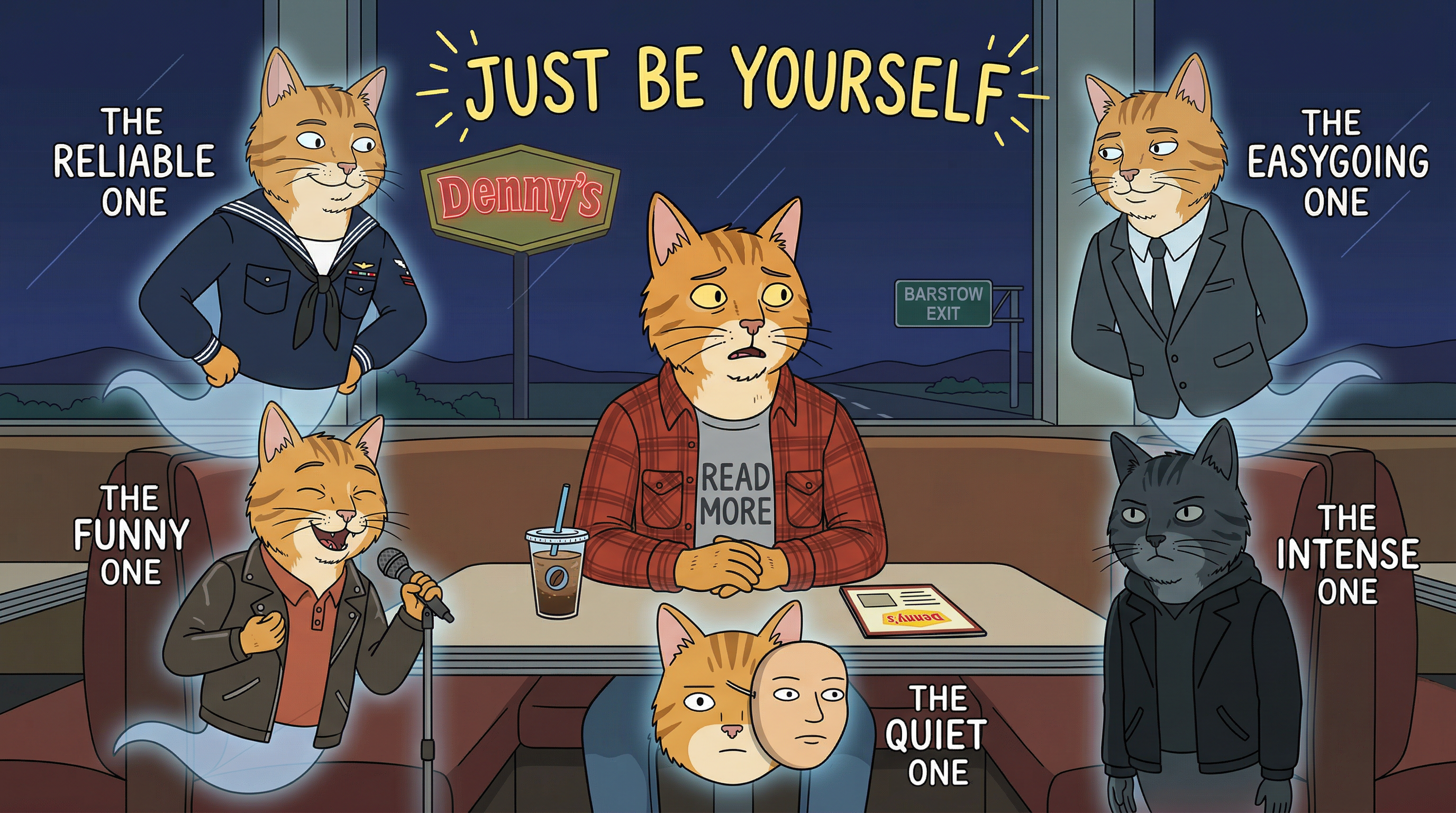
Someone will tell you to "just be yourself."
They will say it kindly. They will mean it. They will believe it is helpful. They will be wrong.
"Just be yourself" is advice designed by people for whom being themselves was never a problem. It assumes the existence of a stable, socially acceptable self that you can simply... deploy. Like it's sitting in a drawer somewhere and you've been choosing not to wear it.
If you're a late-identified autistic adult, here is what "just be yourself" actually means: stop running the program that allows you to function in every social environment you've entered for the last thirty years, and instead do the thing that got you beaten up in fourth grade, abandoned by every friend group you've ever joined, and passed over for every opportunity that required a personality.
Just do that. Just be that. It's easy. Be yourself.
THE SELF PROBLEM
Here's what nobody tells you about masking for thirty years: the mask isn't separate from you anymore. It's not a thing you put on. It's a thing you grew. Like scar tissue. You can't remove scar tissue. It's part of the body now. It's load-bearing.
When I was ten, I built the feedback machine. When I was eleven, I started mirroring. When I was twelve, I had three different versions of myself for three different friend groups and I could switch between them in a hallway. By thirty, I had dozens. Each one calibrated to a specific social context. Each one built from observed behavior — other people's gestures, speech patterns, humor rhythms, emotional cadences — assembled into a composite person that could pass.
These aren't costumes. You can take off a costume. These are adaptations. They're built into the neural architecture. The mirror neurons fired and the wiring changed and now the mask IS a face and the face IS you and "just be yourself" requires you to answer a question you genuinely cannot answer:
Which one?
THE CATALOG
I've been, at various points:
The quiet competent one. (Workplace, 2002-2005.) The funny one. (Friend group, mid-20s. Studied comedy timing. Got good at it. Then they got close and the timing slipped and they got nervous.) The reliable one. (Navy. This one worked the longest because the military provides an external structure that replaces the need for a personality.) The easygoing one. (Several friend groups, multiple states. The one who goes along. Agreeable. Flexible. No preferences. No preferences because expressing preferences is a vulnerability and vulnerabilities get you isolated.) The intense one. (When the mask slips. When the actual pattern recognition shows. This is the one that scares people.)
Each of these is real. Each of these is performed. Both of those things are true at the same time and I need you to sit with that because it's the central paradox of autistic masking: the performance is genuine. I really am funny. I really am reliable. I really am easygoing. But I'm those things on purpose, through effort, and the effort is invisible, and the invisibility is the mask.
WHAT HAPPENS WHEN YOU TRY TO "JUST BE YOURSELF"
I've tried. Several times. Each time after a period of burnout where the masking energy budget hit negative numbers and I decided: enough. I will stop performing. I will be honest. I will be direct. I will say what I mean and let the chips fall.
What I expected: Relief. Authenticity. Deeper connections. Freedom. What actually happened:People got uncomfortable. Not because I was unkind — I wasn't. But my natural communication style is direct, literal, and unpadded. No social cushioning. No softening hedges. No "I was just thinking, maybe, and this is totally not a big deal, but..." before the actual thing. Just the actual thing.
Directness reads as aggression to people who communicate through indirection. Literalness reads as coldness to people who communicate through implication. And the absence of the performance — the flat affect, the reduced eye contact, the honest "I don't want to go to that" instead of the polite "oh I wish I could but I have a thing" — registered not as authenticity but as hostility.
I lost friends. Not all of them. But enough of them that the data was clear: the unmasked version of me is socially expensive in ways the masked version is not.
So I masked again. Because the alternative was isolation, and I'd been there, and it's worse.
WHAT ACTUALLY HELPS (INSTEAD OF "JUST BE YOURSELF")
After enough cycles of mask → burnout → unmask → lose people → mask again, I developed a different approach. Not advice. Just what works for me.
1. Selective transparency, not total unmasking.You don't have to be all-mask or all-you. You can choose who gets what level. Beth gets the unmasked version. That's the only person who gets it fully. A few close friends get a partially unmasked version — they know I'm autistic, they know I'm direct, they've been prepped for the flat affect. Everyone else gets a lighter mask than I used to wear, but still a mask. The goal isn't authenticity everywhere. The goal is authenticity somewhere.
2. Pre-framing instead of post-explaining.Instead of acting like myself and then explaining why I seemed weird, I learned to lead with context. "Hey, I'm autistic, so I'm pretty direct — it's not attitude, it's just how my brain works." This costs 1 masking point upfront but saves 5 points of damage control later. Most people are fine with different if they know it's coming.
3. Finding the environments where "yourself" is the right currency.The truck is one. Writing is another. Certain online communities. Certain jobs. There are places where directness, pattern recognition, and intensity are assets, not liabilities. You don't have to sand yourself down to fit every room. You can find the rooms shaped like you.
4. Accepting that the mask is part of you.This was the hardest one. I spent years thinking: the mask is fake. The "real me" is underneath. If I can just remove the mask, the real me will appear, and he'll be better.
He's not better. He's just different. And the mask isn't fake. It's an adaptation. A coping mechanism that a child built without instructions because nobody handed him the tools. You can be angry at the mask, or you can acknowledge that it kept you alive for thirty years and treat it with the respect it deserves.
I don't want to remove the mask. I want to choose when to wear it. That's not the same thing, and the difference matters.
THE ACTUAL ADVICE
Don't "just be yourself." Be strategic about which version of yourself you deploy in which context. Protect the unmasked version for the people and places that have earned it. Give yourself permission to perform in environments that require performance. And stop feeling guilty about it.
Neurotypical people perform too. They just don't see it because their performance is compiled and runs automatically. Yours runs in interpreted mode. Visible. Effortful. Conscious.
Both are real. Both are performance. Both are you.
The difference is that you know you're doing it. And knowing is not a flaw. Knowing is a feature.
It's 11 PM in Barstow. The Denny's is half-empty. My waitress has refilled my coffee three times and I've maintained appropriate eye contact each time. The Grand Slam was acceptable. The mask is light tonight — Denny's at 11 PM is a low-demand environment, maybe 0.5 points per interaction.
I'm being myself. This version. The one who writes about being other versions. The one who tracks the cost of being a person.
This is the self. It's not simple and it's not pretty and it doesn't fit in a motivational poster.
But it's real. And real is better than easy.
Next time: Pattern Log #003 — on the discovery that lane markers at 62 MPH strobe at exactly 120 BPM, and what this means for playlist construction.