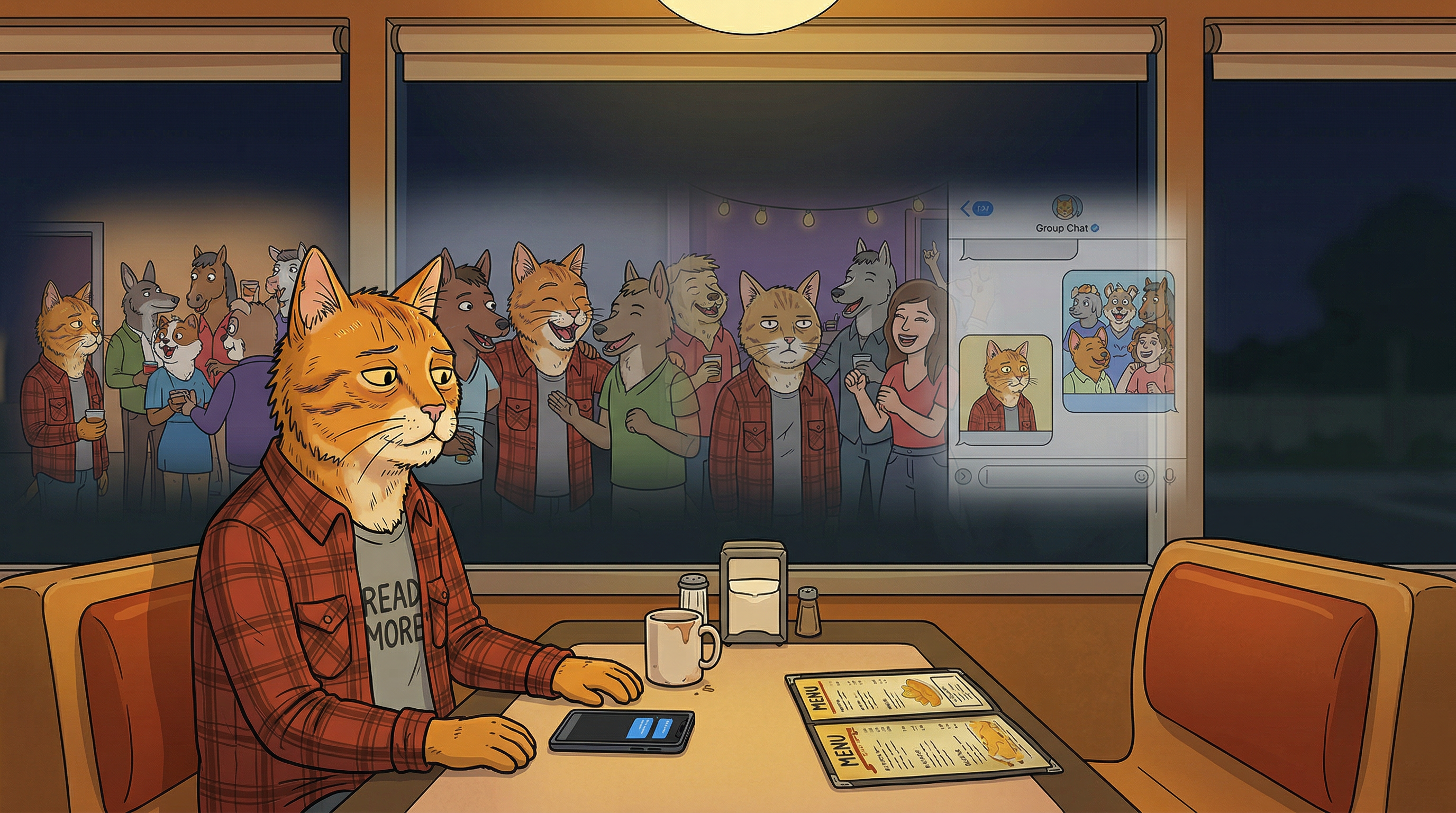
Every friendship I've ever had has followed the same arc. Not similar. The same. Five phases, same order, same duration curve, same ending. I've run this pattern — conservatively — fifteen to twenty times across four decades. The data set is robust. The conclusion is not something I wanted to arrive at.
Every friendship has an expiration date. Not because of betrayal. Not because of some dramatic rupture. Because of proximity. The closer someone gets to me, the more of me they see. And what they see, eventually, is not what they signed up for.
This is not self-pity. This is a pattern log wearing a User Manual's clothes.
PHASE 1: OBSERVATION
New group. New environment. Could be a job, a neighborhood, a bar, a church, a gym, an online community. Doesn't matter. The environment is new, and new means: data collection.
I don't enter a social space. I survey it. Who talks to whom. Who defers. Who leads. What's funny here — not universally funny, but funny to this group. What are the rules. Not the stated rules. The actual rules. The ones that determine who gets included and who gets a polite smile and a closed door.
This takes one to three weeks, depending on the complexity of the group. During this time I am quiet. People read this as shyness, or newness, or being reserved. It's none of those things. It's reconnaissance.
By the end of Phase 1, I have a map. I know the social architecture. I know the load-bearing relationships. I know who the group needs me to be.
And I become that person.
PHASE 2: ACCEPTANCE
This is the good phase. The only good phase.
The mask is fresh. The character is dialed in. I'm mirroring the group's humor, matching their energy, deploying the version of myself that fills whatever gap the group has. Every group has a gap — a role that's unfilled, a frequency that's missing. The funny one. The reliable one. The chill one. The smart one. I find the gap and I fill it, and the fit is so precise that it feels organic.
Because it IS organic. That's the thing I need to say clearly: I'm not faking. The humor is real. The reliability is real. The intelligence is real. Everything I'm showing them exists inside me. The mask doesn't invent — it selects. It takes the parts of me that match what the group needs and puts them in the window, and it puts everything else in a back room where nobody goes.
Phase 2 lasts weeks to months. Sometimes longer. It's the phase where people say "you're so easy to be around" and I think: yes, because I'm spending 3 masking points per hour to make this look effortless. Easy to be around costs 3 points an hour and I start each day with 7.
But it works. They like me. We're friends. I have people. This is the part of the cycle where I let myself believe it might be different this time.
It's never different this time.
PHASE 3: INTIMACY
The friendship deepens. This is supposed to be a good thing. In every book, every movie, every model of human connection I've studied, deepening intimacy is the goal. Getting closer. Knowing each other better. Sharing more.
Here is what "sharing more" means for a masked autistic person: the mask has to cover more surface area.
In Phase 2, the interactions are bounded. A few hours at a time. Specific contexts — the bar, the job, the group hangout. I can mask for a few hours in a specific context. The character is built for that runtime.
Phase 3 is the weekend trip. The late night. The "come hang out Saturday, we're not doing anything, just come over." The unstructured time. The long-duration, low-format social exposure that requires sustained presence without a script.
The mask can't run 24/7. It wasn't built for sustained use. It's a sprint tool being asked to run a marathon, and somewhere around hour six of "just hanging out" — no agenda, no activity, no structure to hide inside — the edges start to fray.
I get quiet. Not strategically quiet — depleted quiet. The wit slows down. The mirroring gets laggy. My responses shorten. My face settles into its resting state, which is flat, which people read as bored or annoyed or checked out. I'm none of those things. I'm at a 1 on the masking budget and every word costs more than I have.
Sometimes it's smaller than that. A response that's too direct. A joke that doesn't land because the timing was real instead of performed. An honest answer to "what's wrong?" — "nothing is wrong, I'm just tired" — delivered in a tone that doesn't sound tired, it sounds cold, because my voice loses its modulation when the energy drops.
They notice. They don't say anything. But they notice.
PHASE 4: THE DRIFT
Nobody announces Phase 4. There's no conversation. No confrontation. That would almost be easier — a fight gives you something to point at, something to fix or grieve.
Phase 4 is quieter than that. It's the text that gets returned three hours later instead of thirty minutes later. The group plan that you hear about after it happened. The invitation that comes with "if you want to" appended, which is social code for "we won't be hurt if you don't," which is social code for "we've already adjusted to your absence."
The group reforms. Not against you — that would require active hostility, and this isn't hostile. The group reforms around your absence. They fill the gap you used to fill. Someone else becomes the funny one or the reliable one. The social architecture adapts because social architecture always adapts, and the version of you that fit the gap is running on fumes and the gap has started healing around someone else.
You're still technically in. Still in the group text. Still invited to the big things. But the texture has changed. The micro-invitations — the "hey, come with me to grab coffee" moments, the spontaneous texts, the small unnecessary gestures that mean "I'm thinking of you when I don't have to be" — those dry up first. And those are the ones that matter. The big invitations are obligation. The small ones are affection. When the small ones stop, the friendship is already over. The rest is paperwork.
PHASE 5: GONE
Not a fight. Not a breakup. Not a dramatic ending. Just entropy. The messages slow. The plans stop. The gap between contacts widens from days to weeks to months to "I should really reach out to..." and then you don't. And they don't. And the friendship joins the archive.
I used to think this was my fault. For thirty years, I thought something was fundamentally wrong with me — some deficit of character, some failure of effort, some inability to maintain what other people maintained effortlessly. I'd replay every friendship that followed this arc and catalog my failures: I should have tried harder, been more available, been warmer, been less intense, been more, been less, been different.
The answer was simpler and harder than all of that: the gap between who they thought I was and who I am widened past the point of connection. The mask created an expectation. The real me couldn't meet it. Not because I didn't want to. Because the mask and the self are different shapes, and the closer someone gets, the more visible the mismatch becomes.
This isn't a tragedy. It's geometry.
AFTER THE IDENTIFICATION
Since the identification, I can see the pattern. All five phases, labeled and indexed. I can feel Phase 1 happening in real time — the surveying, the data collection, the construction of the character. I can identify Phase 2's energy cost as it accrues. I can sense Phase 3 approaching when the invitations shift from bounded to unbounded.
Seeing the pattern doesn't stop it.
I need to be clear about that because the narrative is supposed to go: "I understood the problem and then I fixed it." I didn't fix it. Understanding the mechanism doesn't change the mechanism. My brain still masks. My brain still surveys and mirrors and constructs. The energy budget still depletes. Phase 3 still breaks the mask. Phase 4 still happens quietly.
What changed is the grief.
Before the identification, Phase 5 felt like a verdict. You failed again. You're broken. You can't keep people. The grief was existential — not mourning a friendship, but mourning the possibility that I could ever sustain one.
After the identification, Phase 5 feels like — not acceptance, exactly. More like recognition. Oh. There it is. That's the pattern. That's what happened. Not because I'm broken. Because my brain allocates energy differently than theirs, and sustained proximity costs more than I can pay, and the mask that made connection possible is the same mask that makes connection temporary.
The grief shifts from "what's wrong with me" to "I understand the mechanism."
And that's not nothing. It's not a cure and it's not a fix and it's not a happy ending. But it's a map. And a map doesn't make the terrain easier. It just tells you where the cliff is so you're not surprised when you're falling.
A NOTE ON THE EXCEPTIONS
Not every friendship follows this arc. Beth is an exception. A few others — very few — have survived Phase 3 because the person on the other side had the specific, rare combination of qualities that makes long-term connection possible with someone like me: patience, directness, low demand for performance, and the ability to say "you seem done" without making it a problem.
These people exist. They are rare the way a specific frequency is rare — it's out there, somewhere in the spectrum, but you can't manufacture it and you can't force it and you can't predict where you'll find it. You just keep scanning until you hear it.
I've found maybe four in my whole life. Four people who heard the real frequency and didn't flinch.
Four is enough. Four might be more than most people get, if they're honest about it.
The Waffle House is doing its thing. The grill is hissing. The jukebox is playing something I don't recognize. The waitress has refilled my coffee twice and called me "hon" both times and it cost me zero masking points because Waffle House waitresses are the most efficient social interaction in American dining — they are direct, transactional, and warm without requiring reciprocal warmth. They're built for people like me, though they don't know it.
My phone has two unread texts. One from the group chat I'm currently in Phase 4 with. One from Beth.
I'll answer Beth first. I'll answer the group chat eventually. The pattern is running. I can see it. I can name every phase.
Seeing it doesn't stop it. But it changes the shape of the loss.
Next time: Pattern Log #004 — on the acoustic properties of grocery stores, and the shopping route I built without knowing I was building it.